No one teaches us about marriage or relationships.
No one shows us what good communication looks like or gives us the recipe for successful couples.
We stumble down this path of relationships in the dark.
I found myself without role models and with a dysfunctional past. People showed me love in hurtful ways and I did not know what a healthy relationship looks like.
On the way up the graduate school and professional ladders, we don’t learn the skills we need for the most important things in our lives. No one teaches us how to speak, listen, request, forgive or let go.
How do you become a good doctor? You go to school for it.
How do you become a good cyclist? You ride a lot.
How do you become a better lover in relationship?s Trial and error. Lots of experiences in the name of failure. Breakups. Divorce.
What a way to learn, huh !?!
To improve our relationships, we first have to realize that we don’t know anything about them. IF you grew up in dysfunctional ones, you have to admit that you know only what a dysfunctional relationship looks like.
There is no shame in learning. We learn in every other area of our lives, so why not sit down and study relationships? Why not figure out how to communicate and love another person?
There is a better way to communicate than through complaints, put-downs and negativity.
In this excellent book, The New Rules of Marriage, author Terrence Real outlines 5 ways to improve your communication. I wrote about this book last week and here’s part 2 of what I learned from this book.
Here are 5 winning strategies to become a better lover.
1. Shift from complaint to request.
Complaining rarely or never gets you what you want. Don’t criticize your partner for something they did in the past; instead, ask them for what you want in the future. It takes more courage, and we’re not used to asking for what we want in relationships because complaining is easier and asking poses the threat of rejection. Yet Real tells us that asking is a more empowered way of being. For women particularly, “self-assertion can trigger feelings of shame and guilt. They must learn that pleasure and honest connection are gifts and birthrights.” Real writes that asking for what you want is the only way your partner will be able to meet your needs.
2. Speaking out with love and savvy.
Always remember that the underlying goal of communication is to speak and be effective with the person you love. The goal is to strengthen your bond and relationship. “He is someone you love. Someone you’ve pledged your life to. At the very least, recall that he’s the person you have to live with.” Keep this goal in mind and ask yourself what your communication will do. Think about what you’re going to say – will it bring you closer together or take you further apart? Help your partner feel empowered, not helpless. Talk about what happened during a particular event, then talk about what you have decided about it, how you feel about it and what you would like to happen in the future. Speak to solve the problem and avoid it in the future, not to hurt and embarrass your partner.
3. Respond with generosity.
Before responding, you have to master the art of listening to your partner and understanding where they are coming from. Don’t argue or go for being right – go for harmony and repairing the conflict you’re both experiencing. After listening, you have to understand where your partner is coming from. The rule that Real describes is “understanding builds empathy, empathy builds compassion, and compassion ends combat.” Once you hear your partner out and understand what they are saying, acknowledge what they are saying as much as you can and show accountability. The final part of responding is to respond generously to as many of your partner’s requests. Find something to give to your partner and agree on sincere actions you will take in the future.
4. Empowering each other.
How can I help you give me what I want? Treat your partner as your teammate. “Repair demands that both partners ask: What can we do to work as a team? How can we face challenges life throws at us and the challenges we present to each other in a practical way?” How can you help each other? How are you going to help each other feel loved and fulfilled? Work together on a plan to help each other get what you want.
5. Cherishing.
Cherishing is what you do after you’ve agreed on what you’re going to do to resolve the conflicts between both of you. You have to cultivate your capacity to appreciate and enjoy the pleasure of your relationship. To cherish, you have to acknowledge your partner’s progress and demonstrate, through your actions, a desire to return the favor and be pleasing to them. Let them know that you appreciate them, encourage them for improvements and thank them for doing those things you asked for.
Ready to become a better lover? Or to learn the new rules of marriage so you can transform your relationship? Pick up The New Rules of Marriagetoday.
“We are drawn to people whose issues fit perfectly with our own in a way that guarantees a reenactment of the old, familiar struggle we grew up with.” Terrence Real, The New Rules of Marriage.
As someone who was married for nearly a decade, I went through the ups and downs of marriage.
The downs were really down and took me through these 5 terrible behaviors that people commonly engage in during a marriage.
I felt terrible when I read about these behaviors in the book, The New Rules of Marriage.
What the heck was I thinking?
How could I have committed all 5 of these harmful behaviors when I was married? I started getting angry with myself all over again for having been so lost, blind and hostile.
I would never treat anyone else I know like this, so why my ex?
The New Rules of Marriage hit me in the gut and awakened thoughts of unpleasant behaviors from my past. I didn’t realize they were common and showed up in all troubled relationships.
If you’re still married, I’m bringing this up to remind you that these are unhealthy behaviors that you don’t have to engage in.
If you’re divorced, you’ll remember these behaviors as a wake-up call for your next relationship.
I’ve tried to get over the shame and to stop beating myself up for these negative behaviors. I’m reminding myself that I did the best I could and now self-awareness will help going forward.
5 harmful behaviors to avoid in your marriage.
1. Needing to be right.
If you’re married, you know this one all too well. You want to be right and you refuse to see it another way, for both the small and big things. You may be factually right but being right isn’t the point. You could win the battle but make your spouse feel lousy about themselves and therefore lose the war.
Solution: “The only sensible answer to the question ‘Who’s right and who’s wrong?’ is ‘Who cares?’” Real tells us in his book. We can be right or we can be married – which matters to you more? “I want you to do this: Understand that the need to be right eats away at intimacy, no matter what the provocation. You can make a commitment to stop self-righteous indignation, no matter what the provocation.”
2. Controlling your partner.
We try to get our partners to do what we want them to do. Some do this by force and others by manipulation, but both essentially try to get their partners to behave in a certain way. Real tells us that we naturally feel attraction to people who have a way of pricking our deepest wounds and childhood pains. He tells us that we marry our unfished business. Even the best relationships bring up every hurt and anger you carry inside.
Solution: You don’t have to avoid the raw parts of yourself in a relationship. You can handle and heal the raw parts of yourself, but not in the way you imagined. Your instinct might be to change your partner and get them to behave. “Our understable, naïve and utterly dysfunctional dream is that our partners will give to us whatever we most missed in our childhoods, that we most yearn for now as adults.” Control is an illusion. You can heal and change only yourself, not your partner.
3. Criticism and negativity – giving your partner a piece of your mind.
“Hey, let me tell you in precise, lurid detail just exactly how miserable you made me by your shortcomings. I need to vent!” is the idea that Real describes with what he calls “unbridled self-expression”. It’s telling your partner in brutal honesty what you think of them. If you somehow don’t put it all out there, you feel like you’re suppressing and hiding your true feelings.
Solution: Real says that, “you will not die if you don’t express yourself whenever a thought pops into your mind. Furthermore, venting is not an inalienable right. You can vent or you can move toward a solution.” Find a more thoughtful and careful way to express what you want to say. Try constructive, not critical, self-expression. Realize that telling your partner how horrible you think his/her behavior is or what a horrible person he/she is will not help you get closer or solve any problems.
4. Retaliation.
Who doesn’t love to get even or push your partner’s buttons after you’ve been injured? It’s the idea of thinking of yourself as the victim and hitting your partner harder emotionally than he/she pushed you. Often retaliation comes across as verbal abuse: “humiliating, ridiculing, telling your partner what he should or should not do – these are all aspects of verbal abuse, and they have no place whatsoever in a healthy relationship.”
Solution: Either of you should call a “time out where the arguing comes to an immediate stop. You disrupt the interaction and one of you leave[s] it so there is no further harm done. Check in within twenty minutes or a couple hours or even half a day and see if you each need more time or if you can have a conversation in a more civil manner. “Make a commitment to take retaliation – physical and verbal, direct and indirect – off the table. If you’re mad, say so, but don’t act it out,” advises Real.
5. Withdrawal.
You can withdraw from a conversation or even completely from the marriage. Withdrawal is a passive-aggressive form of retaliation. You withdraw from certain or all aspects of the relationship – intellectual, emotional, physical, sexual and spiritual. You withdraw to avoid conflict, when you’ve given up or when you find it pointless to engage any further in the relationship.
Solution: This is the most blatant strategy that results in your not getting what you want because you’ve stopped trying. You can’t get what you want from a relationship by withdrawing from it. Instead of a unilateral, provocative drawing away, you can opt for responsible distance taking. Provide an explanation for why you don’t want to engage in the conversation now and promise to return to it later, providing a specific time to address the concerns.
You need your space while still remaining accountable and responsible in the relationship. You don’t want to sever ties with your partner. You want to find a way to work it out, have your needs met and be fulfilled.
There are new rules of marriage in the modern age. To deal with all of the marriage-breakers above, pick up The New Rules of Marriage, by Terrence Real, for tips and strategies for articulating your needs and wants, listening well, standing up for yourself and knowing how to seek outside help. You can pick up the book on Amazon here.
It doesn’t matter what you have going on in life. You can comeback. You can start stronger than before the fall. You can move ahead and use adversity as a springboard.
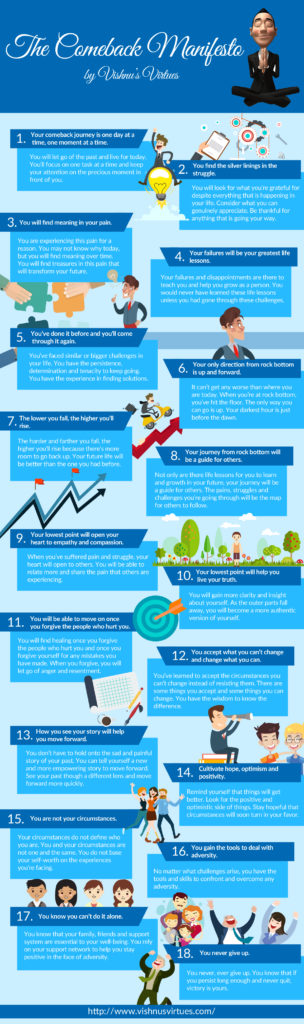
Check out this manifesto with important reminders on your comeback. Whether in love or life, the only direction for you is upward and forward.
It’s been close to 3 years since I separated and later on, divorced from my husband.
We were only officially married for 1 year and half but unofficially together for 7 years. He was my best friend. I looked up to him and secretly felt I could not keep up to his ability to be successful.
Three years ago, l lost sight of everything meaningful in my life, and spiraled into self- sabotage and rebellion. When we broke up, I took it upon myself to change as a person, because I thought that was partly the reason my marriage had deteriorated. What I came to realize is it was the marriage with myself that I never allowed to heal properly. Before we can love someone wholeheartedly, we need to love and accept ourselves first.
Year one taught me survival through various avenues of meditations, traveling, one-on-one coaching, researching topics of interest (self-help), and continuous self-introspective writing.
Year two opened the doors towards discovering who I am, my true self and layers of my mind that contributed to my years of “unconscious” living (along with the help of therapy.)
Year three helped me accept that I am already in the place I need to be and learning to accept myself as I am as well as being more compassionate with myself. It is also more of a “free” year, where I am living day by day and just being with myself not doing anything in particular as previous years – I am actively watching myself “just being me.” (As weird as that sounds!)
I am very clear about the mistakes I made back then.
Marriage is when two imperfect souls can accept each other just as they are and grow as persons and as a unit simultaneously. Marriage is compromise, love, empathy, understanding, strength, vulnerability and maturity amongst the obstacles and difficulties thrown at us by the universe.
Divorce is just another new beginning to look at yourself and reflect on what went wrong.
It’s an opportunity to learn about yourself and to appreciate your previous partner as another teacher in your life (once you move past the anger phase, because you do experience it – and it’s totally normal!)
I learned more about me, then I did after any other difficult time period of my life.
It was hard for me in the first few months, as I am a sensitive individual. Time went so slow, my loved ones spent hours calling me, inviting me over for dinner, and sharing countless words of wisdom. I felt I was experiencing an outer body experience.
Surprisingly, work became more interesting because I drowned myself to avoid feeling pain. I often woke up earlier and fell asleep earlier than usual. I started experiencing anxiety attacks and I started praying frequently again. This only reaffirmed my desire to create change for myself. I am eternally grateful for the spiritual coach who guided me during this time and opened up doorways for my self-improvement (my healing).
Here are my tips to work on healing from your heartache while improving yourself and loving yourself:
1. Don’t lock yourself up indoors.
When we feel down, we feel lifeless, we are walking zombies and we do not want to get out of bed. My godfather told me, “When you feel sad: get up, grab your purse, open the door, and hear it slam. Then, come straight over to our house. No matter how many times. Get up and get out.” You have no idea, how much I have listened to this. Once you are out, you won’t suddenly feel thrilled but after 2hours of engaging with others, laughing or in-depth conversations of moral support, you will feel better.
2. Set intentions and be compassionate with yourself.
If you have no other options, because we tend to close up, then set an intention to be compassionate with yourself. For example, I have very few intimate friends, so I did often stay at home, in bed with the lights off. But, I knew I couldn’t stay there forever. I set a realistic intention to give myself a minimum of 3 days at home. Day 3 came and I would get up to go out or do an activity such as writing, visiting loved ones, going for a walk or seeing a movie.
3. Allow yourself to feel.
Do not avoid it. If you need to talk to someone (you trust) for hours to get things off your chest, do so. We are creatures of service; another person will listen to you and help you feel relaxed. If you don’t have someone, I recommend writing down every thought going through your mind. If you suddenly feel the need to cry or laugh, don’t hold it back. Feel it, watch it, and release it – whatever feeling it is, will go away on its own. Don’t avoid thinking or feeling by working overtime or going out every chance you get as an escape. In the long run, this will bring more harm because pain gets buried and will resurface when a new relationship or situation comes around.
4. Get help from a professional outsider: a coach or therapist.
I met a wonderful life coach through a mutual friend. She guided me in every session, hearing me out, giving exercises, written homework assignments and insight. Sometimes we need another’s eye and expertise to comprehend what we are going through and provide you tools to move forward. There were so many topics and tools I would have never thought of without her. She opened my mind to study myself and be understanding that this new life experience would allow me to reach my goals of healing, true love and self-acceptance.
5. Take a seminar or a class.
When you find yourself as a student again engaging in adding skills to yourself professionally and/or as a hobby – you are left with an overwhelming feeling of accomplishment, giddiness and success. It will make you feel so much better and you will begin to notice you forget about your sadness because you are doing something loving such as an exercise dance class, meet up group, meditation or yoga seminar.
6. Don’t do rebound relationships.
I have done these in the past, though I didn’t do it after my divorce from my last partner. I have found that you are still in a tender phase and you need to work on those feelings of hurt, discomfort and loss. Sometimes, we think we are ready and what we really need is to meet new people and be friends first. If the right partner comes along, you will know it. Don’t rush, take your time.
7. Don’t stay in contact with your ex/exes.
My last ex found it annoying I stayed friends with previous exes. He use to say, “Exes can’t be friends.” I use to debate this all the time. I found it brought me more harm than good, even affecting my marriage. Growing up as an only child with little or no family, we tend to make our friends our family. I couldn’t let go of certain relationships because I was scared to be alone. In past relationships, I had keep my exes as friends but by doing so I only kept it as “yellow” light just in case the flame would revive. In order to move on, we need to keep a distance. Otherwise, we are prolonging pain or in some cases, engaging in relationships with no ties – where there is always one person that gets attached and gets hurt. No matter how much we love or loved that person, we need to let go and accept the one relationship worth keeping is the one with ourselves.
8. Do pray or meditate.
Religion and spirituality continue to be the most contributing part of this healing and self-transformation equation. If you belong to a particular religion, prayer is universal – give it to God. If you are not part of any religion, being spiritual is another tool. Spirituality isn’t all about a religion. It is also about belief in yourself, your inner center, the universe and the stars. I went to free meditation seminars on Sundays during year one and even pulled up some good mediattions and mantras from YouTube. Meditation frees you to – give it to the universe. For me, giving myself to God and the universe through prayer and meditation allowed me to feel peace again, especially in those sad or anxious moments during and after my divorce.
Taizha Diaz, also known as Spiritual Dahlia, writes on her blog here. You can also keep up her work on Facebook.
I am happy to be able to share this interview with you, by my friend, A.G. Billig. Watch this video to find out how to find the love your’re looking for in your life. Learn now to choose love each and every day. A.G. offers some practical tips to see and feel love.
A.G. Billing is an author and self-love coach. You can learn more about her work here at www.agbillig.com. To pick up her book, I Choose Love, visit her Amazon page here.
Hi, I’m Vishnu
I help people overcome their devastating breakups and divorces and find love again. Instead of visiting the Himalayas, sign up below and join me. I am taking a writing break but will be back soon.
This guide is free. A ticket to the Himalayas is $2000. Your move.