6 Ways of Letting Go of the Past and Embracing the Power of Now
“Don’t let the past steal your present.” Terri Guillemets
I have a confession to make.
Anyone who reads my blog knows that I write a lot about pain and heartbreak, inspired primarily by a painful and heart–shattering divorce.
Over the last couple years, divorce has taken me to the depths of my sanity, led me to question my very being and forced me to confront the deepest suffering.
Without question, this life event has held me back, kept me down and paralyzed my life.
It’s a subject I wrote about often, talked about often and thought about, even dreamt about, more often.
I allowed my agonizing thoughts to dominate my life as I embarked upon a steep path of growth and revitalization in my life.
Now that I can look back with a little more clarity, I can see how I replaced a person (my former spouse) with pain. How I made heartbreak and sorrow my companions.
Through a chance conversation with a childhood friend, I was re-introduced late last year to the one author and book that had previously touched my life.
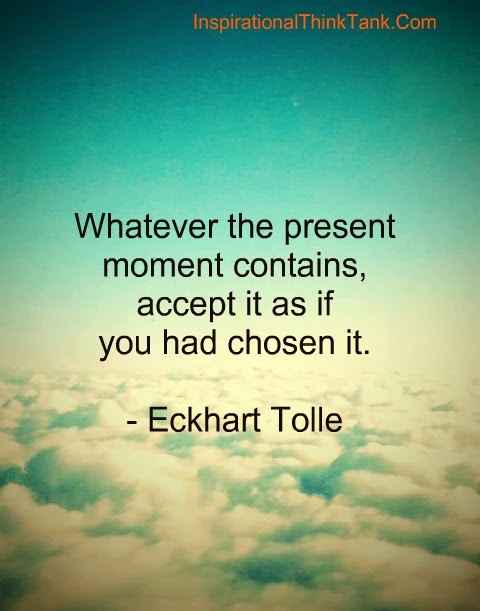
You may also have read this ultimate guide to and celebration of living in the present moment: The Power of Now, by the soft-spoken spiritual teacher, Eckhart Tolle.
Tolle’s message of living in the present moment packs a punch of clarity, wisdom and absolute truth.
How do you live in the present moment?
It’s easy and sometimes even pleasurable to get caught up and live in our past.
You’ve likely experienced struggle, heartbreak, loneliness, failure and loss.
But you know what’s worse than experiencing any of these events once in your life?
Painfully replaying each of these moments over and over again in your mind.
In The Power of Now, Tolle reminds us that we don’t have to replay the horror, the pain, and sorrow of our pasts repeatedly in our minds.
6 “living in the moment” strategies Tolle shares in The Power of Now:
You probably aren’t going to spend another week of your life re-reading Tolle (although I highly recommend it) and it will likely take us all a couple lifetimes to fully understand Tolle’s reflections.
I’m going to take to try to take out the Tolle-speak and seemingly dense spiritual concepts and explain The Power of Now as I understood it.
Here are 6 practical and actionable steps Tolle suggests.
If you simply implement one of the strategies below and shift your mindset, I promise you that your life will change forever.
1. Stop thinking. “What the…!?” you’re wondering as you read this line…
Tolle provides a solution to reoccurring sadness and pain in your life. Your thoughts continue to replay in your mind like your favorite iTunes track.
Each replay is a swift reminder and a continuation of past pain.
“When you listen to that voice, listen to it impartially. That is to say, do not judge…You’ll soon realize: there is the voice, and here I am listening to it, watching it,” Tolle writes.
So sit and become aware of your life’s darkest moments repeating themselves in your thoughts.
In the course of your day, when you feel sadness and loss, just call your thoughts out: “There you go again, mind! Taking me through this roller coaster of emotions. Replaying that sad and tragic past once again…”
Stop the mental replay by becoming aware of the negative.
When you stop thinking of or re-playing painful events in your mind, Tolle says, “You’re no longer energizing the mind through identification with it. This is the beginning of the end of involuntary and compulsive thinking.”
Action: Watch your mind. Or watch for feelings of sadness and pain throughout the day. When you are feeling sorrow or pain, immediately call out the thoughts that led you there.
Thinking about your difficult childhood, the loss of a loved one, your pet dying?
Shine a flashlight on these sneaky thieves wandering around the dark alleys of your mind.
2. Be highly alert in the present moment.
Well, geez, how do you do that? By being completely present in any activity or conversation you are in.
Ask yourself, “Am I in the present moment?” in whatever it is that you’re doing.
“Am I focusing on the task at hand?”
“Am I here or are my thoughts floating in la la land?”
Give normal and everyday activities your full and utmost attention.
As an example, Tolle writes, “Every time you walk up and down the stairs in your house or place of work, pay close attention to every step, every moment, even your breathing. Be totally present.”
Do this while you’re walking around town, getting in and out of the elevator, walking to the train station or wandering around the grocery store.
Be present in every moment by paying as much attention as possible to that moment.
3. Become aware of the pain-body within you.
Tolle defines the pain-body as lingering emotional pain.
He notes that some of us live entirely through our pain-body, whereas in others, the pain-body may be asleep 90% of the time.
For example, I used to be preoccupied with the pain of breaking up about 90% of the time.
My pain-body became ever more important in my life because it gave me a troubling new sense of self.
In the past couple of years, I have spent less time thinking about and experiencing the pain-body of loss and heartache.
When you and I become our pain-bodies, we have something to identify with.
“I’m the person who suffered loss.”
“I’m heart-broken.”
“I’m that person who failed financially.”
After marinating in this identity, you get swept over by a wave of pain, sadness and sorrow, and it supplies you with your identity. Your ego identifies with this pain-body and your pain becomes your self-image. You become your past, your loss and your hurt.
“Once this pain-body has taken you over, you want more pain. You become a victim or a perpetrator. You want to inflict pain, or you want to suffer pain, or both…” Tolle reflects.
So, how do you dissolve this pain-body?
Tolle summarizes this process: “Focus attention on the feeling inside you. Know that it is the pain-body. Accept that it is there. Don’t think about it…don’t judge or analyze. Don’t make yourself an identity out of it.”
“Stay present and continue to be the observer of what is happening inside you…This is the power of the Now, the power of your own conscious presence.”
4. Be aware of the difference between your “life” and “life situation.”
Tolle makes a distinction between your life and your life’s circumstances or situations. He refers to life situations as “psychological time.” Life situations are the past and the future.
You resist what happened to you in the past, don’t accept it in the present and are anxious about the future.
Whatever is happening to you is your life situation, which happened in the past or could happen sometime in the future. Both of those places aren’t the present moment.
Tolle says you could have a lot of situational problems, and most lives are filled with them, but you should find complete comfort and peace in the present moment.
“Use your senses fully. Be where you are. Look around. Just look, don’t interpret. See the lights shapes, colors, textures. Be aware of the silent presence of each thing…” Tolle gently nudges us.
You don’t have to identify with or be defined by your past.
If you accept the present moment, you can deal with those situations as they are.
You can’t change what has happened and what is coming your way: past and future.
All you have at this exact moment is something that needs to be dealt with or accepted. That’s it! “Why make it into a problem?” Tolle inquires.
“All it takes is a simple choice, a simple decision: no matter what happens, I will create no more pain for myself. I will create no more problems.”
Although Tolle says this is a simple choice, I’m certain if you adapt this philosophy and start living it, your life will completely transform. You’ll be a new person who will no longer be crushed by the weight of the past or the future.
5. Drop negativity like a piece of hot coal.
For more happiness and peace of mind, Tolle proposes letting go of negativity.
“How do you drop a piece of hot coal that you are holding in your hand? How do you drop some heavy useless baggage that you are carrying? By recognizing that you don’t want to suffer the pain or carry the burden anymore and then letting go of it.”
You have a choice to be entrenched in your past or to live for the moment that you have right in front of you.
Often we’re chock-full of negativity in our life because we refuse to accept something that happened in the past or are resisting something occurring in the current moment.
Tolle’s suggestion is to choose the current moment and accept what is, choosing to let go of the heavy baggage and drop the hot coals by consciously choosing to let go of the pain of the past.
When you let go of the pain surrounding the past and the negativity associated with it, you will find an ever-present peace of mind in the present moment.
6. Let go of the future. I sure love the future, don’t you? What’s not to love about it?
In my future, there is happiness, bliss, abundance and eternal joy.
Of course, Tolle bursts all our bubbles and insists on prying the future out of our hands.
Forget the future, he says:
“‘When I obtain this or am free of that – then I will be okay’. This is the unconscious mind-set that creates the illusion of salvation in the future,” Tolle writes.
Sure, we could find peace, happiness, and fulfillment some day, or we could scratch that futuristic thinking and chose to have all of that in this very moment.
You don’t need to go anywhere to find this joyful state of being.
“You ‘get’ there by realizing you are there already,” is one of the most powerful Eckhart Tolle quotes in the Power of Now.
I devoured this book once a long while back, but this past year, I really started to understand it, and it’s been a life-changer.
You can CHOOSE to let go of your past pain and suffering.
Become aware of how those past misfortunes resonate with negative feelings, thoughts and emotions.
You suffered once, why suffer again?
The future is a whole other story that isn’t here – you can’t do anything about, can’t change it, can’t guarantee happiness in it. You don’t even know if you’ll be there when you get there. So why live for a tomorrow that may never come?
Live for the present. Live in this very moment.
Change your mindset and accept this very moment. Right now, chose to be happy, choose to let go, to lift that heavy burden off your shoulders and release the heaviness of the past and future this very minute.
Give yourself permission to breathe in and breathe out with peace of mind, acceptance and emotional freedom.
Would it be too much to call this enlightenment?
What are you doing at this very moment? Are you being fully present and going to leave a comment below ? 🙂 Tell me about your experiences or strategies for letting go of the past.