Imagine Christmas morning. Smell of fresh roasted coffee, baked bread, and an aroma of Christmas cookies. Christmas carols playing on the radio.
And some dirty footprints by the Christmas tree. “What the…?!?” You definitely weren’t wearing shoes last night as you dispensed the Christmas gifts under the tree.
“Who the %#@%*@”
That Santa guy just broke into your house again.
Before you start sweeping up the charcoal footprints, clearing his half-eaten plate of cookies or filing a police report on the break-in, let’s look at what Santa Claus has done to Christmas.
Did Santa Claus hijack Christmas?
The dude from the North Pole with magical elves and reindeer who can circle the world in 24 hours is a legend.
He’s in movies, stories, commercials, and is the hero of Christmas around the world.
He makes lists about who’s been good or bad, brings us expensive cool gadgets and captures the imagination of all children.
But has Santa hijacked the meaning of Christmas?
Think about it – this guy has basically flooded the market and capitalized on the birth of God’s son!?!
What a no good son-of-a %*@)*%)@
Instead of celebrating the life of the Savior, born to the Virgin Mary in a stable, we’re stuck with a jolly guy who loves junk food and Coca Cola!
It’s not just Santa but everything he’s come to represent – endless shopping, gift-buying, wrapping paper and bows, lay-aways and credit cards, Black Fridays and Cyber Mondays. Pre-Christmas and After-Christmas sales bonanzas!
Santa has become the poster boy of a giant marketing campaign. Everyone from Coke to Macy’s has made billions of dollars of this guy! The entire U.S. economy has come to depend on year-end gift buying for the holidays!
How to take Christmas back?
Although Santa’s hijacked the holidays, does Christmas have to be about gifts, presents, food and buying stuff?
NO!
HELL NO!
We can take Christmas back. We can celebrate the guy who made it all happen – Jesus, the savior. We can celebrate His birth, what he stood for and how He sacrificed his life! No, that’s not as fun to hear as a jolly red-suited man with presents but Jesus is the reason for the season.
Let’s pull our Bibles out and read a passage. Let’s learn about the man who gave up His life for us. Let’s live a holiday season based upon the principles Jesus taught us and the example he set.
Five ways to celebrate Christmas to make Jesus proud!
1. Go to church. Listen folks, I’m not even a Christian and I’ve been going to Christmas mass for the last few years!
Going to church on Christmas is the ideal situation for the wannabe, non-Church going and disenchanted Christian.
You get to be in Church during the holiest day of the year and celebrate the birth of the Savior. You also hear the gospel, celebrate with music and participate in an activity that’s actually related to the holiday.
How about spending the holidays doing less gift-giving and being more compassionate?
Jesus was compassionate to the hungry, the homeless, the blind, and everyone else around him.
Giving to others in the form of gifts makes you both feel good and results in more stuff!
Being compassionate to others in need, on the other hand, will be a service to help others improve their lives. Give with your money, your time or your attention to a person in need or cause this holiday season.
If you need a toolkit to practice compassion, my friend Sandra has put together a list of resources on her blog. This toolkit is neither approved or endorsed by Santa!
3. Be Kind
Isn’t it interesting that we pull our hair out and are in a mad rush on our way to celebrate Christmas? So many relatives to visit, so many holiday parties, so much shopping to be done.
The craziness of the holidays turns us into demanding, impatient and inconsiderate individuals.
Want to be kinder on Christmas or throughout the year for that matter? Visit Alex Blackwell’s blog to read the manifesto on kindness which features at least 100+ kindness tips.
4. Stop buying stuff
A person’s life, “…is not in in the abundance of the thing which he possesses” Luke 12:15
If you feel that gift-buying and the obligatory purchases of high-end luxury items and technology products doesn’t soothe your soul, then stop the mindless act of purchasing stuff!
Boycott Santa and all his marketing messages. Stop the sales, stop the buy 1 get 1 free, stop the Coke-drinking! Stop getting him cookies! The dude needs to lose weight! (He needs a tough Black Friday workout with Amy Clover to get in shape.)
Instead, take on the Buy Nothing challenge Leo has Babauta has suggested on the Zen Habits blog. Instead of buying whatever the hell you see in sight, stop the madness! Adapt some of the rules Leo’s proposed and cut down on unwanted junk this year for you and for others.
5. Gift experiences. What if instead of giving gifts, we gave experiences?
Instead of stuff, we could give each other our time and attention. We could strengthen our relationships with others by spending time with the people we love and value them. We could give our time and attention to those who need our help.
If Santa shows up at my house, I’m calling the cops this year. I’m leaving the cookies and milk for you, my friends and readers. Have a great holiday and celebrate like Jesus would!
Are you for Santa or for Jesus? How do you stand up to Santa’s aggressive sales and marketing efforts? Yes, you’ll piss Santa off but go ahead and leave a comment below anyways.
Is God listening during life’s dark times? (To read the book I wrote on this subject, click here)
How can we have God play a bigger role in our lives everyday?
Yes, it’s here. Although it’s almost a year after I taped this interview, I’m excited to share this conversation with you.
I spent a few minutes chatting with the inspirational Assistant Pastor Angie Taylor, in Reno, Nevada. We chat about the role of faith in your life, God’s presence during trying times, and how to strengthen our faith.
Dr. Taylor is not only a phenomenal faith-based leader but also a leadership speaker and consultant. To learn more about her, click here.
I hope you enjoy the interview!
To pick up my book, Is God Listening?, click here.
What are your thoughts about God? Do you find God present in your life during challenging times? Please add your comments below.
If the Buddha, Deepak Chopra or your favorite televangelist have not yet made the case to you on why you get more spiritual in your life, you’ve been missing out. I talk a lot about what spirituality can do for you on my blog and today, on my guest post at Pick the Brain.
Spiritually tends to get swept up with far out characters, hokus-pokus practices, and bizarre beliefs. The spiritual people you know you in your life also may not be the best examples for wanting to live a spiritual life. Your hippie Uncle, fortune-telling ex-girlfriend and organic-fasting colleague (who fasts while breathing organic air) make you want to have nothing to do with spiritual people or a practice.
A good spiritual practice is one where you are able to discover your true nature and self. It’s the process of digging through your physical and emotional makeup and reaching the essence of who you are as a person.
Are you for health but don’t have time to eat healthy?
A world-changer but waiting to retire from your corporate Wall Street job before changing the world?
An environmentalist who doesn’t recycle?
Or maybe even someone who is “spiritual, but not religious?”
Which leads us to the question of what the heck is the “spiritual but not religious”?
Multiple choice question. “Spiritual but not religious” means:
A) You’re super religious but don’t want others to know it
B) Non-religious but use this phrase as a way to be politically correct and be socially accepted
C) Kinda religious when it’s Christmas time or someone dies
D) Not religious but spiritual enough to believe that if all this religious crap was for real and you found yourself in hell, you’d use the “spiritual, not religious card” to escape a life in purgatory.
“Is spiritual, not religious” a lame excuse?
It has become socially acceptable to say “spiritual, not religious” when asked what our religious preferences are. It also seems to be the politically correct thing to say.
With “spiritual, but not religious” we get to say that we’re connecting with ourselves, a higher power or God but not in any formal or scripture-based way. And we don’t really have to do ANYTHING to satisfy that label.
How do you end up becoming “spiritual, not religious?”
Did you grow up in a cult and get burnt out?
Did you grow up in a strict religious household where you were constantly warned about going to hell?
Did you grow up in a household where you were told to stay far away from God and march with your comrades when the revolution started?
Did you live a life of faith only to find a God who doesn’t listen to your prayers and continuously disappointed you?
Why get spiritual?
If you’re neither spiritual or religious, fine.
If you’re religious, all the power to you.
But if you’re the “spiritual, not religious crowd” I’m writing this for you. And asking you to get spiritual if in fact you consider yourself a spiritual person.
I’m asking you to get spiritual so —
1) You spend a part of your day focusing on your inner self and being, as you discover who you really are – your essence.
2) You’re able to deal with life’s problems and challenges better with inner strength and wisdom.
3) You realize that spirituality is a part of your personal development practice which allows you to be a better person to yourself and others.
10 Ways To get Spiritual for those without money for church coffers, time to attend religious services or tolerance for doctrines and dogma.
Let’s say you’re hell-bent on staying as far away from any and every religion, prophet, guru and sacred text. Then, try one of these practices for a few minutes a day to get in touch with your inner spirituality.
Stop saying you’re spiritual and get spiritual by:
1) Meditating for a few minutes every day. Close your eyes and focus on your breathing without trying to think about the world around. You’ll become more mindful of your breath and ultimately be able to observe your mind.
2) Attend a yoga class. Yoga may feel like a pure physical exercise. Yoga is actually challenging your body and mind and helping you make the connection between the two.
3) Listen to music which stirs your soul. I would just suggest doing this mindfully so you’re actually listening to the music instead of when you’re on the exercise bike, playing a game of Angry Birds on your iPhone.
4) Attend a gospel concert. Yes, they may be singing about God but you don’t have to ‘hallelujah’ about God. A gospel choir sings about God but also about hope, strength, self-belief and overcoming challenges.
5) Be silent. No, I don’t mean shut up as a spiritual practice. Oh, maybe I do. I say be silent and observe the silence. Embrace the silence. In the silence, you might even hear or find your inner self.
6) Watch your favorite televangelist. And no, you don’t have to pick the one that’s asking you to send in $5,000 to save your soul. TV preachers ain’t all bad and many preach about overcoming life challenges and finding your inner strength during life’s rough times.
7) Take a hike. When you’re one with nature, you can’t help but think about nature and before you know it, your connection with nature. Nature has a way of revealing your true self.
8) Watch a sunset or sunrise. Sure, this sounds like a recipe for a romantic getaway but also a way to uplift your spirit and soul. Glorious sunrises and sunsets may make you even start seeking a higher power.
9) Help someone. Yes, helping others can be a spiritual practice all by itself. The act of giving selflessly to others brings out your best and highest self. Helping a friend when they are overwhelmed, a relative who is struggling or an elderly person with a chore will help you make you feel a spiritual connection.
10) Send love out into the world. Sending out love is something that my friend Wendy Irene regularly writes about on her blog. This may be a little hippie-ish sounding advice you heard when sitting around the campfire at Woodstock. When feeling afraid, overwhelmed or worried for yourself or someone else in your life, feel love and illuminate love for a few minutes.
You don’t have to be religious to be spiritual. But if you think you’re a spiritual person or want to be more spiritually in tune, practice a little more spirituality in your life every day.
You’ll instantly feel the benefits of spiritual living; clarity, strength, compassion and connection.
For my book, Is God Listening?, about spirituality and resilience, click here.
A question that we usually ask ourselves in between watching reality TV and during the last 30 seconds before we fall asleep each day.
It’s a big life question and many religious texts and practices have tried to answer it.
You may find that different people answer this question in different ways – drugs and alcohol will definitely get you enlightened for a few hours. Fancy cars and big houses may make you believe that you’ve been enlightened. A local visit to your temple or church may feel like enlightenment is right around the corner.
But what if you want enlightenment right now? Ok…during this lifetime?
Don’t worry – this story doesn’t end with you spending a lifetime under a Boddhi tree in deep meditation. (Although that has worked for others in the past)
The Bhagavad Gita – no, that’s not what you had for lunch at Taj India buffet.
The sacred Hindu scripture, known as the Bhagavad Gita, provides 3 sacred paths to living an enlightened life. If you’re thinking the Bhagavad Gita was what you had for lunch at Taj India buffet last week, you’re sorely mistaken.
The Bhagavad Gita or “Sacred Song” is a Hindu epic that takes place in a mythical holy battlefield. Arjuna, a hero in this battle and a representation of every human soul who seeks guidance, strategizes how to fight his distant relatives on the battle-field.
This epic conversation between Arjuna (enlightenment-seeker – i.e. you) and the God Krishna takes up about 18 chapters of the Gita and is filled with pearls of wisdom about living and enlightenment.
No matter what you think about Hinduism or holy battles, the message of the Gita is universal. The Gita offers up three paths of salvation and enlightenment that you can put in practice into your life today.
The way of action (Karma Yoga) – Karma here is not in the sense of ‘don’t cheat your neighbor today or someone’s going to show up and slash your car tires tomorrow.’ While surely that can happen, we are talking about Karma in the unselfish action sense.
It is a path that states that you should do your duty in life (studying, working, raising children) but not for external reasons; glory, fame, wealth or praise. You do your life’s work without any expectations of a return.
Karma yoga instructs against taking action for selfish personal gain and suggests enlightenment by working for work’s sake.
When you ignore the ‘fruits’ of your actions, you become less attached to expectations, achievements and results. You can work for the sake of work, which Krishna calls divine work, and a sure-bet towards enlightenment.
So, in a nutshell, carry out life’s duties without expectations or seeking rewards.
The Way of Knowledge (Jnana Yoga)
This is enlightenment through knowledge; reading of texts or learning from wise teachers. Ok, I’ll agree with you – you’re right – reading Vishnu’s Virtues is probably a form of Jnana Yoga. So is picking up a copy of my book, Is God Listening? 🙂
Not the strongest form and definitely not recommended by 9 out of 10 gurus, but it’s one way. And many of you are great Jnana yogis as you may consume your fair share of wisdom-filled blogs (including www.tinybuddha.com, www.everydaygyaan.com, http://evolvingbeings.com/), spiritual texts and even read brilliant realized tweets to achieve the realized state.
Other ways include reading holy scriptures, being guided by wise men and women, meditation and even yoga.
Way of Devotion (Bhakti Yoga) This is the way of devotion or faith. It is the way of love, dedication, faith and worship.
If you sing in joy and celebration of a higher power, you’re practicing bhakti yoga.
Same if you’re praising, worshipping, or reflecting upon the higher powers.
This is a practice of love and praise. Constant and fervorous worship.
5 thing you can do to reach enlightenment today.
The Bhagavad Gita offers 3 ways to start on your path to enlightenment.
You can start on the path to self-realization today.
You don’t even have to sit under a boddhi tree for awareness. Or move to the Himalayas or jump the palace gates like the Buddha.
You don’t need to hit rock bottom or end up in your life’s lowest point to start your path to enlightenment.
You don’t need a groom running away at the alter, house foreclosure or income tax audit to help you get to the point of seeking spiritual realization.
1. Start working for the sake of work without minding so much about the results, achievements or goals. Yes, Hindu wisdom would say live a goal-free life. You can have goals in life but don’t expect enlightenment through a constant achievement of goals.
2. Read, inquire, question, learn. Check out practices, books, knowledge and other spiritual paths to start on your own path towards enlightenment. Enlightenment won’t happen overnight but you can start on your path today.
3. Worship, pray, meditate and make a connection with the higher powers in the universe.Some sort of an active spiritual practice can help you start your path to enlightenment.
4. Be a better human. Who knows? Maybe ultimately being enlightened is really about realizing that there’s a higher power that governs the universe. If this is the case, that higher power must be everywhere including within every human. Is enlightenment simply realizing this and being kinder, more loving and compassionate towards others?
5. Attend a rafastarian concert and rock out to reggae music. If you think enlightenment is utter nonsense and have no desire to get started on any spiritual path, I dare you to attend a reggae concert and not come out spiritually enlightened. Sure, it may be a temporary state of euphoria (until the smoke clears) but you’ll have a taste of what enlightenment could feel like.
A Sikh candlelight vigil, remembering the Wisconsin victims.
Tragedy can strike at any moment.
Even in the most sacred times – while you’re at the temple praying, in the midst of a divine moment. This can happen in the most sacred of places and the most public of places.
Which is exactly what happened in Wisconsin last week at the Oak Creek Sikh Gurdwara (temple). 6 people died tragically, left their families and loved ones behind and are being eulogized in funerals this week.
The tragedy, like the shootings in Colorado earlier this year, are profoundly sad, appear to be senseless and affects each one of us, no matter where we live and what religion we practice.
This is not a Sikh tragedy but a human one.
While I’m not Sikh by religion, I share a country of origin, India, where Sikhs hail from. I’ve found the people who practice the Sikh faith to be extremely devoted to their religion, peaceful, loving and kind.
Sikhs have gotten a bad rap, in America, because they wear turbans and have beards; characteristics of Osama bin Laden.
Why turbans? Not only is it one of the tenets of their religion, but as the Huffington post columnist recently pointed out, Sikh gurus instructed Sikhs to wear turbans to rebel against India’s caste system and to represent equality between poor and rich. The turban was encouraged to be worn by all classes of Sikhs to represent equality in God’s eyes.
It’s unknown why the lone gunman in Wisconsin unleashed this horrific act of violence against this devoted and peaceful community. But the tragedy has once again confronted us as a community, as a society and as individuals.
How do we personally deal with pain and suffering when tragedy strikes?
Here are 5 ways:
1) Reflect. When tragedy strikes, it’s easy to jump to conclusions, feed off stereotypes and hatred and take action we may regret later.
Instead, after a tragedy strikes, reflect. Reflect upon what happened, reflect upon your feelings and how the tragedy impacted you. Try to understand why you’re feeling the way you are.
Observe anger, the sadness and the other emotions the tragedy causes within you.
2) Gather and reach out. When tragedy struck in Wisconsin, Sikhs around the United States had vigils in many gurdwaras around the country. This was a time for communities to gather and meet each; to comfort each other and try to collectively understand what happened.
While you may want to reflect on the tragedy yourself, you may find it helpful to be with others and reflect as a group. You may feel like you’re less alone and feel a stronger support network. By reaching out to others, you’ll be help others more seriously affected by the tragedy to move forward.
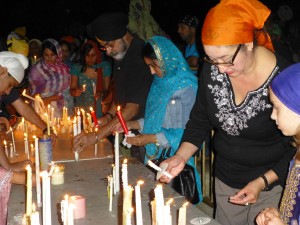
Here are a couple photos of the the beautiful candlelight vigil and prayer I attended in San Jose, California where the community gathered and mourned together:
Lighting candles in remembrance.
In reflection
Community gathers for candlelight vigil.
3) Learn and understand. Tragedies present you with an opportunity for better learning and understanding.
Ask yourself what the tragedy means to you and your community?
Did the tragedy happen because of stereotypes, hatred, ignorance or some other reason?
What caused the tragedy and what can be done to avoid similar happenings in the future? Is it time to improve the cultural dialogue? Time to reach out and get to know our neighbors? Time to deal with mental health issues?
Learning and understanding from a tragedy is not only a healing process but can help make you and those affected even stronger than before and help your community avoid it in the future.
4) Help and give. When others are going through man-made or natural tragedies, we might want to sit home and mourn. It’s easier to watch television and empathize with the affected people than to actually do something.
Instead, see what you can do to help those impacted by the tragedy.
Ask yourself what you can do to help. Although tragedies seem to happen far away from us, they are not that far away. It probably happened in a community similar to yours with the same types of neighbors, same types of issues and similar people.
What can you do to help others and give back? Can it be as simple as making a donation? Is it putting together a care package? Is it writing notes of support and reaching out to the victims?
Is it championing an issue or cause that the tragedy raised?
Doing something, anything, in the face of tragedy, is also a healing activity that can help you move on. Helping others by rebuilding a community or giving back allows you to take something sad and hopeless and make it positive, as Sikh community leader, Valerie Kaur, noted about the emerging generation of Sikh Americans in her recent Washingtong Post article.
5) Take time to heal. We don’t heal overnight. Healing takes time. Reflect, learn, understand and take time to heal when tragedy strikes – especially when it’s close to you or your community.
Don’t continuously reflect upon the tragedy and take a break from it if you’re able to. Try living as normally as possible, do things you love, meet up with friends and try to partake in your regular daily activities.
Also, let’s not kid ourselves, tragedies can have psychological and emotional impact. Some events can trigger emotional or psychological wounds especially if you’ve experienced something similar before.
If you need the help of a counselor or psychologist; seek it. Just talking to someone else about what happened may help you come to terms with the incident and help you move on.
What do you do when tragedy strikes? How have you dealt with tragedy in the past? How can we heal, reflect and move on with our lives? Please share in the comments below.
I help people overcome their devastating breakups and divorces and find love again. Instead of visiting the Himalayas, sign up below and join me. I am taking a writing break but will be back soon.
This guide is free. A ticket to the Himalayas is $2000. Your move.