Lord, shut down this blog. Then, please save this man's soul.
4 a.m.’s in the prayer room.
I’d be trying to stay awake while folded up in an uncomfortable lotus-style seating position next to my devoted grandparents.
The smell of camphor and incense sticks either put me in a dreamy daze or might have made me high. I haven’t quite determined which – did the camphor and incense sticks set up the atmosphere necessary for hallucinations or spiritual awakenings?
As my grandparents arranged fresh garden flowers upon the statutes of Siva, Ganesh and the Goddess Lakshmi, I found myself in and out of consciousness. When they noticed, I’d pep up and chant a verse or two of their morning devotionals with them. When their eyes were closed in prayer, I would be in a deep slumber.
From the earliest days of childhood through growing up in Northern California, with daily home prayers and pujas, regular visits to temples that were no closer than a 6-hour drive away by car and two Sunday school classes (nope, not just on Sunday’s either) I grew up in a strong Hindu family with a strong faith.
You grow up with your family’s religion.
Similar to your favorite foods and political views, you most likely practice the religion of your family.
Your eating preferences, life-style, health habits, and ‘eccentric’ personality were probably all shaped by your immediate family or loved one.
Now, if you grew up soaking in the Talmud and spent all your after-school hours playing chess at the synagogue, you’re most like a practicing Jew.
If you grew up with rosary-chanting grandparents, daily Mass attendance and spent a good portion of the year sacrificing hard liquor, horse betting or Cappuccinos , you’re most likely a practicing Catholic today. Or at least, go to Mass on Christmas eve 🙂 and call in your prayers when Notre Dame takes on the Wolverines every year on the football field.
What if the religion you grew up with doesn’t fit you?
We grow up with the faith and religious traditions of our families but they may not necessarily be yours.
Once you start confronting your faith and resolving if it’s a right fit for you, like those high school jeans you still try to fit into but have clearly outgrown, you wonder if the religion of your parents is the one for you.
Does the God and tradition of your faith resonate with you? Are you going to find enlightenment here? Do the scriptures seem palatable to you?
Experiment your way to your faith.
While your parents and family may think this practice I’m about to suggest is bizarre or blasphemous and I’m anticipating bans of this blog by most major world religions – why not give other traditions and religious practices a fair shake?
1) Visit other houses of worship. If you’re not familiar with church-hopping, I highly recommend you give it a try. Not just a church, but maybe a temple, synagogue or gudwara. And of course this is only for those of you not practicing your faith, may not believe in or have lingering questions about your faith.
2) Take other friends with you who can explain their faiths and traditions to you. I started going to church with friends who were familiar with the traditions and the practices. That’s the main reason I didn’t take money out of the tithing plates or ask for a second glass of wine at Mass. You need to attend the new place of worship with someone who can lead the way.
3) Use opportunities you meet with leaders and practicing members of other faiths to question (cross-examine) them. If you see folks wearing robes of other religious traditions, like Buddhist monks or Jain priests, do not, I repeat do not, call Homeland Security. Instead, befriend them and ask about their faith, practice and beliefs. You can determine once and for all, if they’re in la la land or they’re sitting on ancient truths and wisdom you should look into yourself.
4) Start practicing and attending their regular worships. If you find a faith that interests you, start going regularly and try to find out if this is some kind of secret cult or your quickest path to salvation. If they ask you to stand upside your head, empty your wallets and money and hand out bottles of Ciroc Vodka, you’re likely in the wrong place.
5) Read their books and scriptures. No better way to get the lowdown on a religion than see what their prophets, devotees, or spiritual leaders had to say. If the book puts you to sleep, put the religion down and move ten feet back. If the good book transforms your life, you may have the found a religion that fits.
If you’re looking for salvation or just peace of mind and devotion, don’t give up. If the faith you grew up with doesn’t resonate with you, be open to learning about other faiths and beliefs.
Hindu philosophy says get with the God that makes you holler. Not exactly in those words but you get what I’m saying.
Christianity says let the holy spirit win over your soul. Again not exact words, but who’s keeping track here?
You may feel like you’re back-stabbing your family and abandoning your faith but are you really? Aren’t you finding the practice that suits you better? Unearthing the short-cut to the G.O.D?
While your parents may include scotch and liquerish chocolates in their regular diet, don’t you have your preferences in regards to wine, men and dairy-free organic chocolates?
Our mind often seeks what is familiar to us, my friend Tim Brownson regularly points out and even wrote a book about it, but your faith doesn’t have to operate by familiarity – it’s a choice.
Find the God, scripture and traditions which suit you.
Me
Jesus is making a big play for my heart and soul. The scripture, the poetic Psalms and His life sacrifice have brought me to the pews of the Church.
You
While I wait for the holy spirit to instruct me further, I ask you friends – are you ready for a conversion?
Ok, fine, are you willing to give another religion a shot? Are you happy in your faith? Was it because of your parents and traditions or did your faith grow out of your own choosing?
“Prayer does not change God, but it changes him who prays“Soren Kierkesgaard
What do you pray for in your life?
If you were anything like me as a kid, you prayed for your favorite toys and electronic gadgets to show up on Christmas, acing your exams, winning the soccer match and longing for your favorite pizza to manifest for dinner.
Later in life, you might have prayed for admission into the college of your dreams, professional success, marital harmony, healthy children, and lots of moolah $$
What you pray for.
Often in life, we pray to God for material possessions (a new Iphone, pay raises or your own tropical island), personal favors (like the Giants winning the World Series or the cop letting you go without ticketing your) and for a stroke or luck (winning the lottery or your stock broker actually being right for once 🙂
Nothing wrong with praying for favors.
In fact, God is there for your favors. If you live by God’s laws and obey His command, you’re going to reap the rewards of His favor.
But sometimes, life puts us through trials and tribulations. We don’t always get what we want. The house, the man of our dreams, the job or the financial security we desired may not materialize.
We then blame God. And wonder why he has forsaken us.
You can pray for favor but consider praying for the prayers that can transform you.
The prayers than can transform your life.
“Enter into His gates with thanksgiving, And into His courts with praise. Be thankful to Him, and bless His name.” Psalm 100
You have more in your life than you can imagine. And more to be thankful for than what you desire in your life. Instead of wanting, why not be appreciative for the blessings you do have?
Why pray for the promotion when you can be thankful for the job? Why pray for a bigger house when you can be grateful for the one you’re already living in?
Instead of asking in prayer, be grateful in prayer.
Pray for strength.
We tend to ask God to help us solve situations, fix circumstances and change the calamities in our lives. When you’re down and scuffling with life, you ask God why He’s testing you? You wish God can abracadabra the situation and change it.
What if instead of asking for a change of circumstance, you pray for strength to deal with whatever tribulations come your way? It doesn’t matter how horrific, heart-breaking or soul-crushing, why don’t we ask God to give us the mental and emotional power to tackle the pains and hurts we confront?
Give us the ability to reach out to the get the help we need, to find the scriptures that soothe us, to have the power to bear life’s challenges.
Pray for humility.
Ever asked God for fame and recognition in the eyes of friends and family? Ever asked for attention and recognition?
Why not ask for humility instead. Humble with the gifts that God has given us. Humble for the special qualities we have. Humble for the many blessings we have in our lives.
When we’re walking around with our head held high and our egos on the loose, ask God to put our lives in perspective for us. Help us tame our ego. Help us think about others and not ourselves.
Pray for others.
We tend to focus on ourselves in prayer. ‘Oh, God help me win this game. Help me write this book. Help me find peace. Help me land the job.’
We are us-focused. Why not pray for the problems and challenges our family, friends, colleagues and neighbors face?
Ask God to help them, guide them, lead them and lead them. Let’s turn our focus from us to others. Let’s ask God to give strength to those who need it. Those grieving, those hurting, those who have lost everything.
Pray for hope.
Your situation may be unimaginable and dark. Ask God to fill with you hope. To remind you and take you towards the flicker of light at top of the summit. Similar to praying for strength, finding the inner abilty to always be more positive. To seek a better tomorrow. To be able to deal with what comes our way knowing it will get better.
Pray for self-awareness and understanding.
We often think we’re in the right and everyone else is in the wrong. We think we are the ones who have it figured out. What’s wrong with everyone else? Why does it seem like everyone else has lost their mind? Why is the problem so challenging?
Why don’t your parents, husband, clients or children understand you?
Seek understanding. That you may not know everything about yourself but seek the inner knowledge to know more about yourself. That your thoughts become clearer. Your intuition becomes stronger. Your awareness of your behavior, perspective and actions makes more sense to you.
You can step back and be more mindful of yourself. This may take prayer to achieve. It may take meditation.
Pray for compassion.
Pray that you’re able to empathize for yourself and others. Be able to take it easy on yourself. Pray that you don’t view yourself as a failure and you can accept yourself for the person you are. And that you can extend that same compassion for others. You can feel, understand and put yourself in the shoes of others.
That you’ll be able to share in their grief and problems.
Pray for patience.
Why do you demand everything happen immediately in your life? When it comes to the plane taking off on time or in God responding your prayers?
Why can’t you wait for five minutes or 5 years. Pray that you’ll have the patience to not know when, how long, how far or how often and that you’ll be ok with that.
Pray for forgiveness.
Forgiving those that have wronged you is hard. Although the wrongs may be petty, the monstrous ego gets in the way and tells us that we are right, we’ve done no wrong and that we deserve the apology.
Pray that you can forgive. Pray that others may not know what they’re doing sometimes. That others may be lost, confused, mistaken, unaware, and hurt your unintentionally.
Pray for wisdom.
Pray that you will be wiser with every passing day. That you’ll understand the world better today. Understand yourself better. Understand God better. Understand the truths of the world better. You will learn the lessons that God has been trying to teach you your entire life.
Friends, if you’re going to pray, don’t put God in a tough spot. Don’t demand your stock portfolio double or your damaged car won’t cost you an arm and a leg.
Don’t pray for quick-fixes and Godfather-like-favors.
Pray for what really matters. Pray for the qualities that can transform your life.
If I don't eat you in .04 seconds, there is a God!
Piercing almond-shaped eyes.
Crushing-molars being sharpened like knife blades preparing to indulge you like a sumptuous delicacy.
Orange striped carnivorous animal, lying in wait to pounce at you at a moment’s notice.
The majestic Bengal tiger of South India.
Named Richard Parker.
Huh?
Well, Richard Parker, the name of the Bengal tiger in Yann Martel’s book and now movie, may have a funny name but is not as casual of a creature as his name makes him out to be.
If you’ve read the book or watched the movie, you’ll be familiar with the fictional story of the Patel family moving their zoo animals from South India to Canada. The Japanese cargo ship the family is traveling on capsizes in a violent storm and Pi Patel spends the next 200 + days of his life on a small life boat with a Bengal tiger, named Richard Parker.
Which God saves Pi’s life?
Throughout the novel, we learn Pi’s epic venture is both a religious and spiritual one.
Prior to Pi’s epic journey, Pi is toying with the idea of being a Muslim, Hindu or a Christian. In fact, he practices all three religions angering the local clergy of all faiths.
“But he can’t be a Hindu, Christian and Muslim. It’s impossible. He must choose” the religious clergy declare as they congregate in his house, at the same time.
With the eyes of a minister, a priest, the Imam and both his parents on him, Pi blurts out “Bapu Gandhi said ‘All religions are true’ I just want to love God”.
After months of consternation and feeling the glaring eyes of the spiritual crowd in his house, Pi’s father chimes in to offer his support, “I supposed that’s what we’re all trying to do – love God”.
Throughout the book, Pi reaches out to God and we can only imagine that it must been some phenomenal power that keeps Pi alive. And carries him across the Ocean for more than 200 some days. Oh yeah, with the company of a BENGAL TIGER!!
Was it the miraculous power of God, of all faiths and religions, which saves Pi’s life?
Pi was indiscriminate in his preference for a particular God – in fact, he believed in the God of all faiths equally.
Is there only one God?
According to Hindu traditions and dogma, there is also one universal God or ‘Brahman’. Hinduism actually believes that there are many paths to reach this God.
The Hindus believe that there’s no need to get into the details of how you reach the divine – as long as you’re trying to reach enlightenment through the path or religion that serves you best.
You don’t have to go with Ganesha, Shiva or Vishnu (the God, not the blogger) to attain salvation – you can just as well get there through Jesus or the teachings of the Buddha.
Which religion has the truth? Which one does God prefer?
Those of other religions and faiths would most likely call the Hindus universal acceptance of all religions and Gods ridiculous, even blasphemy.
Many religions want a mandate – that heir faith and their faith alone will get you to enlightenment, realization, divinity.
But could the God of one religion be the God of all religions?
Could there be only one God like there is only one sun? For example, people viewing the sun from different locations all around the world. Everyone will have a different perception/angle from where they stand on the planet but ultimately they’re all only viewing one sun?
Is God present in all religions?
Does God cozy up to anyone seeking Him and trying to live more divinely?
Or does God have the ins with your religion and planning to help you get on the VIP list to the club called salvation?
What do you believe? Please leave a comment below and chime in.
Imagine Christmas morning. Smell of fresh roasted coffee, baked bread, and an aroma of Christmas cookies. Christmas carols playing on the radio.
And some dirty footprints by the Christmas tree. “What the…?!?” You definitely weren’t wearing shoes last night as you dispensed the Christmas gifts under the tree.
“Who the %#@%*@”
That Santa guy just broke into your house again.
Before you start sweeping up the charcoal footprints, clearing his half-eaten plate of cookies or filing a police report on the break-in, let’s look at what Santa Claus has done to Christmas.
Did Santa Claus hijack Christmas?
The dude from the North Pole with magical elves and reindeer who can circle the world in 24 hours is a legend.
He’s in movies, stories, commercials, and is the hero of Christmas around the world.
He makes lists about who’s been good or bad, brings us expensive cool gadgets and captures the imagination of all children.
But has Santa hijacked the meaning of Christmas?
Think about it – this guy has basically flooded the market and capitalized on the birth of God’s son!?!
What a no good son-of-a %*@)*%)@
Instead of celebrating the life of the Savior, born to the Virgin Mary in a stable, we’re stuck with a jolly guy who loves junk food and Coca Cola!
It’s not just Santa but everything he’s come to represent – endless shopping, gift-buying, wrapping paper and bows, lay-aways and credit cards, Black Fridays and Cyber Mondays. Pre-Christmas and After-Christmas sales bonanzas!
Santa has become the poster boy of a giant marketing campaign. Everyone from Coke to Macy’s has made billions of dollars of this guy! The entire U.S. economy has come to depend on year-end gift buying for the holidays!
How to take Christmas back?
Although Santa’s hijacked the holidays, does Christmas have to be about gifts, presents, food and buying stuff?
NO!
HELL NO!
We can take Christmas back. We can celebrate the guy who made it all happen – Jesus, the savior. We can celebrate His birth, what he stood for and how He sacrificed his life! No, that’s not as fun to hear as a jolly red-suited man with presents but Jesus is the reason for the season.
Let’s pull our Bibles out and read a passage. Let’s learn about the man who gave up His life for us. Let’s live a holiday season based upon the principles Jesus taught us and the example he set.
Five ways to celebrate Christmas to make Jesus proud!
1. Go to church. Listen folks, I’m not even a Christian and I’ve been going to Christmas mass for the last few years!
Going to church on Christmas is the ideal situation for the wannabe, non-Church going and disenchanted Christian.
You get to be in Church during the holiest day of the year and celebrate the birth of the Savior. You also hear the gospel, celebrate with music and participate in an activity that’s actually related to the holiday.
How about spending the holidays doing less gift-giving and being more compassionate?
Jesus was compassionate to the hungry, the homeless, the blind, and everyone else around him.
Giving to others in the form of gifts makes you both feel good and results in more stuff!
Being compassionate to others in need, on the other hand, will be a service to help others improve their lives. Give with your money, your time or your attention to a person in need or cause this holiday season.
If you need a toolkit to practice compassion, my friend Sandra has put together a list of resources on her blog. This toolkit is neither approved or endorsed by Santa!
3. Be Kind
Isn’t it interesting that we pull our hair out and are in a mad rush on our way to celebrate Christmas? So many relatives to visit, so many holiday parties, so much shopping to be done.
The craziness of the holidays turns us into demanding, impatient and inconsiderate individuals.
Want to be kinder on Christmas or throughout the year for that matter? Visit Alex Blackwell’s blog to read the manifesto on kindness which features at least 100+ kindness tips.
4. Stop buying stuff
A person’s life, “…is not in in the abundance of the thing which he possesses” Luke 12:15
If you feel that gift-buying and the obligatory purchases of high-end luxury items and technology products doesn’t soothe your soul, then stop the mindless act of purchasing stuff!
Boycott Santa and all his marketing messages. Stop the sales, stop the buy 1 get 1 free, stop the Coke-drinking! Stop getting him cookies! The dude needs to lose weight! (He needs a tough Black Friday workout with Amy Clover to get in shape.)
Instead, take on the Buy Nothing challenge Leo has Babauta has suggested on the Zen Habits blog. Instead of buying whatever the hell you see in sight, stop the madness! Adapt some of the rules Leo’s proposed and cut down on unwanted junk this year for you and for others.
5. Gift experiences. What if instead of giving gifts, we gave experiences?
Instead of stuff, we could give each other our time and attention. We could strengthen our relationships with others by spending time with the people we love and value them. We could give our time and attention to those who need our help.
If Santa shows up at my house, I’m calling the cops this year. I’m leaving the cookies and milk for you, my friends and readers. Have a great holiday and celebrate like Jesus would!
Are you for Santa or for Jesus? How do you stand up to Santa’s aggressive sales and marketing efforts? Yes, you’ll piss Santa off but go ahead and leave a comment below anyways.
Is God listening during life’s dark times? (To read the book I wrote on this subject, click here)
How can we have God play a bigger role in our lives everyday?
Yes, it’s here. Although it’s almost a year after I taped this interview, I’m excited to share this conversation with you.
I spent a few minutes chatting with the inspirational Assistant Pastor Angie Taylor, in Reno, Nevada. We chat about the role of faith in your life, God’s presence during trying times, and how to strengthen our faith.
Dr. Taylor is not only a phenomenal faith-based leader but also a leadership speaker and consultant. To learn more about her, click here.
I hope you enjoy the interview!
To pick up my book, Is God Listening?, click here.
What are your thoughts about God? Do you find God present in your life during challenging times? Please add your comments below.
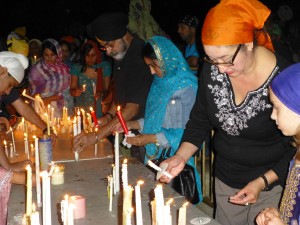
A Sikh candlelight vigil, remembering the Wisconsin victims.
Tragedy can strike at any moment.
Even in the most sacred times – while you’re at the temple praying, in the midst of a divine moment. This can happen in the most sacred of places and the most public of places.
Which is exactly what happened in Wisconsin last week at the Oak Creek Sikh Gurdwara (temple). 6 people died tragically, left their families and loved ones behind and are being eulogized in funerals this week.
The tragedy, like the shootings in Colorado earlier this year, are profoundly sad, appear to be senseless and affects each one of us, no matter where we live and what religion we practice.
This is not a Sikh tragedy but a human one.
While I’m not Sikh by religion, I share a country of origin, India, where Sikhs hail from. I’ve found the people who practice the Sikh faith to be extremely devoted to their religion, peaceful, loving and kind.
Sikhs have gotten a bad rap, in America, because they wear turbans and have beards; characteristics of Osama bin Laden.
Why turbans? Not only is it one of the tenets of their religion, but as the Huffington post columnist recently pointed out, Sikh gurus instructed Sikhs to wear turbans to rebel against India’s caste system and to represent equality between poor and rich. The turban was encouraged to be worn by all classes of Sikhs to represent equality in God’s eyes.
It’s unknown why the lone gunman in Wisconsin unleashed this horrific act of violence against this devoted and peaceful community. But the tragedy has once again confronted us as a community, as a society and as individuals.
How do we personally deal with pain and suffering when tragedy strikes?
Here are 5 ways:
1) Reflect. When tragedy strikes, it’s easy to jump to conclusions, feed off stereotypes and hatred and take action we may regret later.
Instead, after a tragedy strikes, reflect. Reflect upon what happened, reflect upon your feelings and how the tragedy impacted you. Try to understand why you’re feeling the way you are.
Observe anger, the sadness and the other emotions the tragedy causes within you.
2) Gather and reach out. When tragedy struck in Wisconsin, Sikhs around the United States had vigils in many gurdwaras around the country. This was a time for communities to gather and meet each; to comfort each other and try to collectively understand what happened.
While you may want to reflect on the tragedy yourself, you may find it helpful to be with others and reflect as a group. You may feel like you’re less alone and feel a stronger support network. By reaching out to others, you’ll be help others more seriously affected by the tragedy to move forward.
Here are a couple photos of the the beautiful candlelight vigil and prayer I attended in San Jose, California where the community gathered and mourned together:
Lighting candles in remembrance.
In reflection
Community gathers for candlelight vigil.
3) Learn and understand. Tragedies present you with an opportunity for better learning and understanding.
Ask yourself what the tragedy means to you and your community?
Did the tragedy happen because of stereotypes, hatred, ignorance or some other reason?
What caused the tragedy and what can be done to avoid similar happenings in the future? Is it time to improve the cultural dialogue? Time to reach out and get to know our neighbors? Time to deal with mental health issues?
Learning and understanding from a tragedy is not only a healing process but can help make you and those affected even stronger than before and help your community avoid it in the future.
4) Help and give. When others are going through man-made or natural tragedies, we might want to sit home and mourn. It’s easier to watch television and empathize with the affected people than to actually do something.
Instead, see what you can do to help those impacted by the tragedy.
Ask yourself what you can do to help. Although tragedies seem to happen far away from us, they are not that far away. It probably happened in a community similar to yours with the same types of neighbors, same types of issues and similar people.
What can you do to help others and give back? Can it be as simple as making a donation? Is it putting together a care package? Is it writing notes of support and reaching out to the victims?
Is it championing an issue or cause that the tragedy raised?
Doing something, anything, in the face of tragedy, is also a healing activity that can help you move on. Helping others by rebuilding a community or giving back allows you to take something sad and hopeless and make it positive, as Sikh community leader, Valerie Kaur, noted about the emerging generation of Sikh Americans in her recent Washingtong Post article.
5) Take time to heal. We don’t heal overnight. Healing takes time. Reflect, learn, understand and take time to heal when tragedy strikes – especially when it’s close to you or your community.
Don’t continuously reflect upon the tragedy and take a break from it if you’re able to. Try living as normally as possible, do things you love, meet up with friends and try to partake in your regular daily activities.
Also, let’s not kid ourselves, tragedies can have psychological and emotional impact. Some events can trigger emotional or psychological wounds especially if you’ve experienced something similar before.
If you need the help of a counselor or psychologist; seek it. Just talking to someone else about what happened may help you come to terms with the incident and help you move on.
What do you do when tragedy strikes? How have you dealt with tragedy in the past? How can we heal, reflect and move on with our lives? Please share in the comments below.
I help people overcome their devastating breakups and divorces and find love again. Instead of visiting the Himalayas, sign up below and join me. I am taking a writing break but will be back soon.
This guide is free. A ticket to the Himalayas is $2000. Your move.