Do you ever wonder if you’re being lied to by society?
Does it feel like you’re being hoodwinked to live a certain kind of life and it just doesn’t feel right to you?
I sure did and when my life fell apart after my divorce, I was able to wake up and come out my deep metaphorical coma.
I came to the profound realization that my whole life was premised on societal expectations. Everything from work and school to relationships and what I should be doing with my life was created by society’s demands.
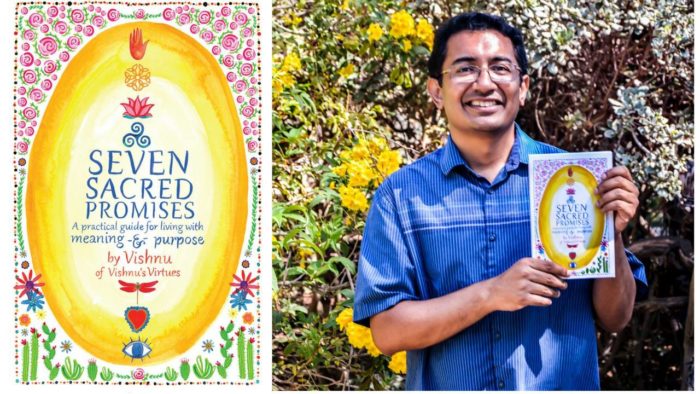
This past year, I put all my thoughts about this topic into a book called, Seven Sacred Promises.
Why do I call these promises sacred? What are these promises? What will living these promises mean to your life?
If you’d like to hear more about the book and my first podcast interview with my friend, A.G. Billig, check out the podcast below.
Pick up this book to learn how to build up courage, discover your calling, find your courage and live your truth. Read this book only if you’re ready to wake up and start living from a sacred space.
If you’re interested in reading the Seven Sacred Promises, you can pick up the e-book on Amazon here or pickup the paperback book here.
Life on the outside can seem like you have everything going for you.
You could be a professional in a lucrative dental practice with speaking opportunities all over the world. You could have a six-figure Bollywod wedding and a million dollar dream home.
Your life appears to be sailing along exactly as your high-expectation Asian parents would have wanted you to live it.
Yet while the external parts of your life are going well and it appears you’ve achieved worldly success, your life could be completely falling apart.
Neeta Bushan’s story that the world couldn’t see is one of pain, challenges and loss. Specifically, losing both her parents and one of her brothers through separate health issues by the time she was 19 years old.
As a child of Indian-Filipino parents who grew up in the U.S., Neeta found herself having to deal with high expectations and academic excellence which took her to dental school and a successful dentistry practice.
Yet, 3 members of her immediate family (including her parents) passed away in her teenage years and she later found herself getting divorced after a physically and emotionally abusive relationship.
For someone who has experienced so much pain and overcoming what seems like insurmountable life experiences, Neeta has captured her life lessons and shares her wisdom in her book, Emotional Grit.
While the book is focused on leadership and building emotional grit in the workplace, I was able to pick out nuggets of wisdom on how she overcame loss, divorce and suffering in her own life.
Here are 5 ways to help you build emotional resiliency when you’re confronting your life’s biggest struggles:
1. Understanding and accepting your emotions.
So much of your life is spent on running away from your emotions because your emotions make you feel uncomfortable and you have been taught to suppress them your whole life. To move forward, you have to be willing to recognize, affirm and apply emotional intelligence to the emotions you’re experiencing. You have to learn to process emotions and learn tools to master the feelings that show up when life challenges that come your way.
2. Positivity and gratitude.
Neeta encourages you to surround yourself with positive messages and daily reminders. “From cards and magazines to picture and clippings, fill your surrounding with images and words that inspire your confidence and enrich your soul,” she writes. Not only does positivity help with keeping your perspective in life but so does gratitude. Waking up to another day is a gift that you can’t take for granted. Remind yourself every day of all those things that you’re grateful for in your life. There are many small and wonderful things in your life that you’re likely not noticing. Wake up each morning and take stock of what you’re thankful for.
3. Be proactive with your mental wellbeing.
In addition to your emotional wellbeing, your mental health is just as important to your wellbeing. Being able to manage stress and being proactive about your mental health are important. You can’t take care of yourself or others when you’re in mental turmoil. You can’t move on or move forward in your life without clearing the mental blocks you face. Reach out to a team of professionals like therapists and counselors if you need one. Otherwise, have a solid community and friendships to listen to you and create space for you.
4. Forgive and Release
Forgiveness may be difficult for you but it’s essential to be able to move forward. Forgiving is saying out loud that you’re letting go of the emotions you’re holding about a particular person or experience. When you forgive, you release all the pent-up energy and emotions about the person and gain your power back but as you know, forgiveness is no easy task. You have to find the courage to forgive and remind yourself of all the benefits of forgiveness. Forgiveness contributes to healthier relationships, less stress and anxiety and higher self-esteem. Not forgiving is like moving through life with a ripped and heavy paper bag, which keeps ripping and things fall out. Forgiveness is putting down the bag and moving forward with more ease.
5. Choose Courage
When you confront difficult circumstances, your fears and anxiety about the past pop up. There are patterns that you grew up with that cause you to act a certain way when dealing with new or challenging circumstances.
“When we choose to be ruled by fear, and specifically when we allow the not-yet-happened to subsume our personal power, we’ve given up the only freedom we have: the freedom to choose,” writes Neeta in the chapter about having the courage to feel your fears.
The way to practice courage is to be more aware your patterns of fear. She encourages you to write down the things that scare you each day and then write down steps to unmask or deconstruct that fear. Even the tiniest of steps in breaking through your fear can lead to more steps of courage.
While emotional intelligence and courage can be helpful in facing personal life challenges, it can also be helpful to your work life. Much of Neeta’s book, Emotional Grit, can guide you to be more authentic, courageous and emotionally resilient in the workplace.
Neeta Bhushan is an emotional intelligence advocate, speaker, and founder of the Global Grit Institute. You can follow her blog here and pick up her book, Emotional Grit here.
“To love oneself is the beginning of a lifelong romance.” Oscar Wilde
In my twenties, I had control issues that prevented me from truly falling in love.
I had a boyfriend who genuinely loved me and we were together for over 8 years. Only, I never truly fell in love. That truth didn’t set me free as much as it scared me.
The root of that fear is what my journey of self-love has been about.
I believe it is the root and source of all emotional pain.
I mustered courage to end that long term relationship and later had a few short term romances that ended abruptly and hurt tremendously.
So, I avoided men which reduced my chances of falling in love and ultimately getting hurt. I was ambivalent about romance because of my upbringing.
Given my parent’s violent quarrels and painful exchanges, you could understand my ambivalence.
I rationalized that I needed to love myself first before I could be in a relationship.
My wise therapist suggested working on loving myself while dating.
I was reluctant, but realized that I had unsuccessfully tried loving myself even when I hadn’t been in a relationship.
I worked through some of my many issues and became adept at processing feelings but not at feeling the extent of my wounding.
Still, I inched closer to a love-affair with myself by putting effort into my relationship with a new boyfriend.
So how do you love yourself when you are in a relationship?
Self -love requires your willingness to be very intimate, vulnerable, honest and courageous to admit the truth about what you think and how you feel.
It requires surrender and making time to be with ourselves to listen to our whole being.
Here are 6 ways to fall in love with yourself:
1. Intimacy is energy circulating within you in love and trust.
You become an explorer of your inner domain. Intimacy is letting your guard down and welcoming every experience. Intimacy creates sensitivity to self and others. You become aware of everything you are feeling.
It means trusting that the Universe is providing everything you need.
To be intimate, you must be vulnerable.
2. Vulnerability is willingness to experience your insecurities.
It isn’t so much about disclosing your insecurities to others as it is about being with your insecurities.
Vulnerability requires honesty and courage to yourself.
3. Honesty means you tell the truth to yourself.
It requires trust and conscious emotional awareness.
Your emotions offer important messages.
Avoiding these messages is not growth promoting nor very loving.
Honesty takes courage.
4. Courage means you are willing to experience your pain including any bodily sensations.
It requires attention to what you are feeling in your body and what you are thinking moment by moment.
It doesn’t mean examining or studying your experience or thoughts.
Self-love requires courage to surrender.
5. Surrender is letting go of controlling what is or what may or may not happen.
Embrace rather than resist your pain.
Experience your pain. Feel your pain.
Love whether of self or others becomes more graceful when you simply surrender to what is, including what you feel.
You must feel the depth of your pain which is at the root your fear that you lack value.
To feel deeply you have to make time.
6. Time with yourself is valuing yourself enough to listen to yourself.
Being aware of what you are experiencing allows you to introspect which means coming to an understanding of your experience.
The key is not getting lost in the mental aspect of introspection without first feeling your pain.
It is being emotionally aware while not being absorbed by your emotions. Your conscious awareness empowers you so you are not swept away by your emotions.
Self-love is a journey and practice of being intimate, vulnerable, honest, and courageous. These form the foundation of self-love. Other elements help you to actively love yourself like patience, good self-care, kindness, self-validation, setting boundaries, forgiveness, etc.
The beauty of your journey is that opportunities for growth and greater self-love arise continuously. What is vital to loving yourself is a firm decision and willingness to venture to live life as well as a commitment to expand your own love.
You don’t live life by thinking about it.
You live by experiencing.
If you struggle to love yourself, it is likely you don’t fall in love easily.
It points to a tendency to be caught in your mind.
Being absorbed in your thoughts means you are not fully present to live your life. If you think too much then you need to remind yourself to feel with your body.
“Like lovemaking it is a whole body experience not just a mental exercise.”
You don’t hold back but give in to the knowing of your whole being.
The universal human experience of falling in love is referred to as a ‘fall’ as it happens unexpectedly.
You don’t struggle or plan the fall, it just happens.
You don’t attempt to control your feelings for doing so compromises our freedom and happiness.
When you value yourself, you do things that fulfill you and makes you happy.
Self- love as well as love for others is real when it makes you feel open, free, and happy.
My hands were clasped together, pulled tight behind my back. A dirty rag stuffed into my mouth. A dimly lit lamp swinging slowly in the background.
“I’ll only untie you if you agree to marry him”, she hissed. “We’ve given his family our word. You can’t break it.”
I closed my eyes and imagined my life 5 years in the future.
If I went for Option A – agreeing to the arranged marriage – I saw a thug of a husband, 3 children I didn’t want to have with him, and a life comprised of cooking his meals and washing his clothes.
And Option B? Implied saying no to the marriage, running away from my family, and in constant hiding from the ruthless bounty hunter at my heels.
Neither was appealing. But a decision had to be made.
And so, with a heavy heart and pangs of guilt, I slowly nodded my head. My eyes filled to the brim with tears. I reluctantly prepared myself for the future.
What do you think? Is this really how my marriage was arranged?
Thankfully not (my life isn’t half as exciting as a scene from Homeland).
And yet? This is pretty much what the majority of the Western world assumes – that marriages in the Indian and Pakistani community are arranged because one party (or both) is forced into a decision.
That neither the guy, nor the girl, set eyes on each other before the wedding day.
And that every girl getting dressed in her bridal clothes hopes she looks like Deepika Padukone in the photos.
(OK, so the last one’s kinda true).
The arrangement of my marriage was pretty simple.
I knew who my husband-to-be was. So, we hadn’t dated for 2 years and I didn’t know his shoe size, but I did know his favourite cricket player – that was enough, right?
My mum sat me down and asked if I was happy to marry him. Her jaw dropped to the floor when I said yes. The shock was so profound that she asked me twice again, in complete disbelief, just to make sure I hadn’t completely lost my mind.
I hadn’t.
What I had lost, however, was my dad. Three days earlier.
And when my mum asked me if I’d marry this man, I couldn’t bring myself to say no.
She’d just become a widow. I could see the pressure she was under from her family to make a decision about the future of her children.
You have to marry your children soon, her relatives pressed. Your husband died and who knows how quickly you’ll go. You can’t leave them alone.
The principle of loss-aversion at work, folks.
My mum had become a widow too young. The last thing I wanted to do was break her heart further.
So I agreed to the marriage.
Not because I loved him, or even knew if I liked him … but because I realised that I was young, too. If the marriage worked, then I’d found my partner early and could finally stop agonising over whether my phone was broken becausethat cute guy who asked for my number three days ago? Still hasn’t called.
And if the marriage didn’t work, I was young enough to start over.
So I went into it. With my eyes fully open.
It was the moment that defined my transition from child to adult.
I realised truly how in control of my life I was. It hit me, square in the face, that my decisions were mine to make. The consequences were clear to me, and they were mine to live.
Even if, as some people later told me, I was being emotionally blackmailed. Even though my dad’s death was being exploited to force a decision from both me and my mum.
The decision, at the end of it, was still mine.
I see a lot of people in the Indian and Pakistani community talking about how they don’t want to bow to family pressure and marry someone they don’t love. And yet, this is what they feel they must do.
My advice to you? Is to stop whinging, and be brave.
Ok, so your parents won’t be impressed that instead of agreeing to marry Rahul, the sprightly, young pediatric surgeon from the finer part of town, you’re busy swapping doe-eyed dreams of beach holidays and white picket fences with Mark from college.
But if this is your decision? Have conviction in it.
If this is what you really want? Use this belief to fuel your next move.
But Razwana! I hear you cry from way over the Atlantic. How can I tell my parents that I’m shattering their dreams and defying their every wish for me? They’ve done so much for me! I can’t let them down like this!
What about all the shame I’ll bring on the family for choosing someone they don’t want me to marry?
What if they don’t let me see my siblings ever again? Or even step into the house? What then? And what if they disown me?
What if, indeed.
The thing with those pesky little what-if’s? Is that they rarely happen.
The decision you make isn’t about whether you marry this person or that:
It’s about the person you want to be
Do you want to be the person who takes action from what they feel in their gut to be true?
Or do you want to be the person who knows what they want, but decides to do what they’re told because it’s the easy route to take?
And that is the easy route.
The tough route? Is making a decision for you, despite what everyone around you will think.
It’s being aware of the consequences ( -> different to being happy with them) of your decision, and moving forward anyway.
It’s about being brave and standing up for your beliefs.
As for me – my arranged marriage went ahead. I didn’t look like Dipika Padukone in my bridal outfit, but I did feel like a million dollars.
But did my marriage last?
Well that, my friends, is a story for another day.
Razwana Wahid: Killer content copywriter and founder of Relentless Movement – A copywriting service for entrepreneurs who want to write bold and sell big. Lose the headache of writing your Home Page, About Page and Services page and get the no-brainer templates here.
To pick up Vishnu’s book, Arranged Marriage: Run to the Altar or Run for Your Life, click here. It’s available for free on July 20th and July 21st, 2015.
“Everything you’ve ever wanted is on the other side of fear.” George Addair
Plunking your feet up on a hammock on a sandy beach in the Maldives and sipping on coconut water.
Relaxing.
Snorkeling at Lord Howe Island in New South Wales, Australia with 500 species of fish and 90 coral species in nature’s paradise.
Easy.
Facing your fears and going for your dreams? Not so much.
Although you may have a dream that has captured your heart, it’s easier dreaming about starting a business, making it in Hollywood or becoming a fully-fledged doctor than actually doing something about it.
Making a dream come alive is hard work. Sometimes very hard work, because it’s fraught with the resistance of our fears.
My path to my dreams.
A few yeas ago when I was practicing law, I decided that I wanted to start my own practice: my own legal office providing services to clients primarily online. Of course, once the idea took hold of my heart, I was quite resistant to it.
How could I start my own practice? What did I know about business? How confident was I in my own skills? How effective would an Internet-based law office be?
The fears started bombarding me on a daily basis.
Despite facing my deepest fears of failure and uncertainty about how well this online law firm would turn out, I forged ahead.
I planned ahead, took small steps, found a mentor, established a website, sent out newsletters, got clients and started earning money to support myself. I soon left my day job and transitioned to my online legal practice full-time.
The journey was long and arduous. And scary. Making ends meet, supporting myself and being able to re-invest profits in the business every few months was nerve-wracking.
I’m happy to say that I continued this business for a couple of years and successfully closed the practice. I had achieved moderate success and was running an established business, but I was beginning to feel that the law wasn’t quite fitting in with my values in life.
I went back to a day job and let go of the anxiety of working for myself. I’m really proud of this experience because I was able to show myself that I could do what I had feared.
Fast forward a few years later to this very blog you’re reading now.
Another life-long dream was beginning to pester me. Throughout my life, I had been drawn to the world of personal development and spirituality. I had learned many concepts and studied various methods of self-improvement (and I had a lot to say about them).
I had been coaching friends and collegues on various issues related to confidence, courage and following their dreams. I noticed that that much of the advice I was giving to one person applied to others as well.
I decided to start a personal development and spirituality blog to help people on their life journeys to overcoming fears, finding their callings and cultivating the courage to live their dreams.
Guess what happened again?
Those inner voices of resistance. Who will read your blog? What do you really know about personal development? How could you ever be in a space that successful bloggers like Leo Babauta, Celestine Chua and Farnoosh Brock had already occupied?
Despite these fears and doubts, I forged ahead again. After a couple years of studying and planning for my blog debut, I launched the blog. It’s been a uphill challenging journey once again. I’ve had moments of self-doubt, instances I wanted to quit, thoughts that made me doubt my ability to write this blog and my purpose for doing so in the first place.
There were posts that no one commented on. Posts that no one shared. Writer’s block. Rewrites to my about page. Rewrites to my tagline. Rewrites to what my blog was about.
The blog was this ever-evolving process and I felt like I was in the dark most of the time, but nearly 2 ½ years later, I have some positive developments to report.
There are more than 600 people who have signed up to read my mostly weekly updates. (What do you mean, why not every week? When else would I find time to binge-watch Oprah’s Super Soul Sundays and attend month-long meditation retreats in search of enlightenment and good vegan food? Never. Exactly.)
More than a few thousand people make their way to my blog every month and actually find it useful, practical, or hey, at least entertaining!
People write me messages like this one I received below on Twitter, which I’m inspired by and grateful for.
In addition to a good readership and some of my writing resonating with people, I took this life-changing life coaching course with my spiritual guru, life coach, Tim Brownson, to learn the ins and outs of coaching. Tim helped me take some of the life lessons I had learned and my passion for self-improvement to teach me effective techniques and strategies to coach others.
I learned the art of powerful questions, how to reframe and reshape our lives and the absolute brilliance of getting clear on values in our lives. Tim gave me the tools, the courage and the confidence to start coaching others.
So a few months ago, I added a coaching page to the blog and now coach clients around the world on how to live more courageously, get through difficult transitions in their lives, and live their dreams.
No, it’s not my full-time job (yet), but I am on my way there. I’m overcoming my fears (even as we speak) by telling you that I’m doing this work. I’ve been reluctant to tell even you – my readers – that I now offer coaching because I’ve been afraid of what you’d think, if you’d think I could really help you or if you could really benefit from my coaching.
This is despite the fact that I’ve coached dozens of people in my life in various capacities. I ran a college admissions consulting business and coached young people on discovering their dreams and pursuing degrees that most fit with their goals. I’ve coached my legal clients through issues that had nothing to do with law, political candidates on matters far outside politics, and friends who have sought me out as their own life coach and advisor.
In pursuit of this dream, I’ve had to fight my fears and my doubts. And as you can hopefully see from the progression of this blog, I’ve been able to walk through some of fear’s tricky behavior.
It’s not been easy. It’s taken hard work to write more than 100,000 words of content, guest blog on other blogs, sit up morning and night to commit to building this community and business.
But this is the price of a dream.
Dream-catching has also required a daily stand-off with fears and uncertainties that have plagued me: ”What am I doing? Am I capable of doing this? Is this ever going anywhere?”
I am here to tell you mid-journey, I’m doing it. I’m living the dream. Yes, I had to create it, but it can be done. I’m here to remind you that you can do it too if you decide to come to terms with the barriers that are detracting you from living your dreams and keeping you stuck. Principally, your fears.
And as you can imagine, having worked through some of my fears and reflected on how I dealt with them, I’d like to offer you a handful of practical strategies to help you work through your fears and achieve your dreams.
What’s preventing you from achieving your dreams?
The fears that we face when following dreams.
Self-doubt. Every time you want to do something, you question if you have the ability, capability and skill to get it done. You doubt your ability to achieve the task or think you’re not good enough.
Voices of our critics. They’ve become our inner voice these days, but the people who doubted us, criticized us, told us we were unworthy and incapable start playing in our heads. We have heard these negative voices from the people closest to us, and we now hear this voice in our thoughts.
It’s not worth the risk. We think about how it takes too much time, money, effort and risk to pursue our dreams. We have a mental checklist of all the problems, shortcomings, and issues that could arise.
The fear of failure. And success. We are afraid of failing, but it’s also our fear of success which holds us back. Not only are we worried about all things that could go wrong, but our minds are nervous about everything going right. We are afraid of achieving our dreams and the happiness and success that follow.
The fear of standing out. We want to be part of the crowd. We don’t want to stand out like a sore thumb. Our fear of being ourselves, fear of rejection and fear of being alone further stand in the way of our dreams.
First, let me suggest 4 provocative questions to help you change your mindset about fear, followed by 17 strategies you can use to be more courageous when facing your fears.
4 questions to challenge yourself about your dreams.
Will you settle for a mediocre life?
This question asks you to consider the type of life you want to lead. Are you comfortable with living an average life without any great achievements or defeats? Will you settle for ho-hum?
Will you regret not having followed your dream?
What would happen if you didn’t follow your dream? How would your life feel if you didn’t achieve or even start on your dreams? Are you ok with allowing your dreams to die a silent death? What do you lose and miss out on when you don’t follow your dreams?
What if your life ended tomorrow?
Similar to the last question, what if tomorrow were your last day on earth? What would you do today about your dream? Pursue it, live it or let it go?
Also, if death met you tomorrow, what do you want to be remembered for? What do you want people to say about you at your funeral, about how you lived your life and how you pursued your dreams?
What would you do if you knew you couldn’t fail?
What actions would you take and what would you do if you knew success was certain? That no matter what, circumstances wouldn’t let you down. How much more likely would you to be follow your dreams? What would you do this very moment?
17 practical strategies to tackle the fears standing in the way of your dreams.
1. You’ve done it before, you can do it again. Take a step back and count all your life accomplishments, minor achievements and major life breakthroughs.
You’ve confronted fears, overcome obstacles and achieved your dreams repeatedly. You learned how to ride a bicycle, learned how to swim, got your driver’s license, passed difficult exams, won soccer tournaments, (or American Idol maybe, if you’re Carrie Underwood) and got cast in the movie Zero Dark Thirty (Jessica Chastain) after a lifetime of dedication to theater.
You’ve done it before and done it well. Use your record of achievement to help inspire you to take on the dream at hand.
2. Prove your fears wrong. Your fears may be very real to you, but could they also be False Evidence Appearing Real? You don’t have to accept your fears at face value.
Try to identify and list your fears about pursuing a dream. Make a comprehensive and detailed list. Now respond in writing to these fears. Are there contrary reasons or perspectives on why your fear is misplaced? Misguided? Or plain false? Can you prove your fears wrong?
3. When do you feel most confident and fearless?
There have been times in your life you’ve felt fearless and absolutely confident.
You may have a talent, skill or ability that you know you can do with your eyes closed, be it writing a report, closing a home sale, cooking a difficult dish or mastering a certain kind of ballroom dance.
Use those moments of greatness as fuel for your current dream. What if you cultivated the same confidence for the dream that’s pulling at your heart?
4. Consider the worst that can happen.
What if you did ask for a raise? Your boss could say no, then get angry with you and fire you. They could put you on a no-hire list and give you a terrible recommendation for other jobs. Now that you’ve taken this to the extreme, how likely is this to happen?
What if you did asked your dream guy out on a date? He could say no. Then check your Facebook profile, fall in love with your best friend and propose marriage to her. You’d be asked to be the maid of honor at their wedding and godmother to their children? Is the worst that can happen that bad? And more important, is the worst-case scenario really that likely to occur?
Since you’re already preoccupied with fears, take your fears to the most extreme level.
5. Let go of the big picture and start with the smallest step. You have a brilliant and radiant dream that includes quitting your job, becoming a billionaire while pursuing your passion, buying up a few islands in Fiji and starting your mornings with Bloody Marys.
Yet starting on a dream like that could be frustrating and paralyzing. Although it’s good to know the final destination, consider the most immediate and smallest step you could take and take that step tomorrow.
By small, I mean tiny. If you want to be a writer, write each day for five minutes. If you want to open a bakery, buy the ingredients to experiment with your first cake. If you want to marry George Clooney, become an international leading human rights lawyer.
6. Always know that you can let go of a dream if it’s not for you. You may also feel paralyzed by starting because once you’ve begun, you’re in it for the long run. Not true.
Just like how you gave up that instrument you hated to play or the roommate who had a hookah machine in her room or the career that inspired you to use up all your sick days and quit, you can quit a dream.
If it’s not right for you, there are ways out. You’re not signing up for a life sentence. Start today and see where it takes you. Know there’s always an exit available mid-stream.
7. Create time for your dream and do it consistently. Your fears may be swirling around in your mind and eating away at your heart.
You don’t have to combat your fears or fight them. Instead, take some action on them. Not big bold steps. How about small, tiny, but consistent ones?
Again, writing for a few minutes a day. Reading business books a few minutes a day. Starting with an easier yoga class on your way to better fitness. Listening to an audio book on how to be a better public speaker or perusing new recipes in a cookbook.
Whatever your dream, make time for it and calendar it in.
8. Become aware of obstacles, distractions and resistance. That sale at French Connection or Roopam’s, near the Chhatrapati Shivaji Terminus railway station in Mumbai, sure is distracting.
So is having to clean your flat from top to bottom, including washing the windows, steam-cleaning the carpet and shampooing the sofas.
You may experience these unknown urges to fill up your time with tasks that can’t wait or things you’ve been putting off for ages.
When you feel there’s no better time for a guilty pleasure or dreaded task, become aware that these activities you’re opting for represent another form of resistance and procrastination.
Become aware that petty tasks and unavoidable errands are simply distractions. They can wait. Your dreams can’t.
9. Stay inspired by others who have achieved their dreams.
At one time in their lives, they were just souls with dreams, but then they went about achieving them. Before she sold 300 million records, Madonna was just a girl from Michigan with a dream. Before Lady Gaga became the best-selling musician of all times, Stefani Germanotta was just a art and theater enthusiast in New York.
Stephen King’s first book, Carrie, was rejected 30 times before he went on to sell over 350 million books worldwide. Steven Spielberg was rejected twice by the University of Southern California film school before he became one of the world’s most acclaimed directors. Dr. Seuss was rejected by 27 publishers. Oprah was demoted from her job as a news anchor.
History is filled with people who have gone after their dreams and achieved them even after setback. Learn about them, be inspired by them, and get in gear so you can start on the path to your dream.
10. Don’t seek validation of or opinions on your dreams.
You can be inspired by others, but don’t look to others around you for support, validation or encouragement.
In fact, keep your dream to yourself if you can. It’s ironic that the people who love us the most and care most about us are often the people who discount our dreams and discourage us.
They’re trying to be “practical”, be wise friends or look out for your best interests. Or they could be fearful for you and want to hold you back. They were too afraid to pursue their dreams and definitely don’t want you to see you achieving your greatness.
For the most part, keep your dreams to yourself and go about the task of achieving your dreams. You don’t need to talk your dream up to all those around you. Just live your dream and show people you can do it.
11. Pursue your goals, but focus on how you feel internally on the way to your dreams.
Small goals or milestones can be important in helping you achieve your dream. If you’re the goal-oriented type, make sure you follow Leonie Dawson’s advice and write them down! Her recent post discussed how writing down your goals and reviewing them is a habit of the highest achievers.
Just as important as goals is how you feel internally.
If you’re pursuing something that meets standards and deadlines but hate doing it, your fears will be roaring at you.
So, when pursuing your dream, consider and validate how you’re feeling. Check in with yourself emotionally and be willing to make the necessary adjustments.
Pursue those things you’re passionate about, and you will naturally find the courage to keep at them.
Another technique is to cultivate the feelings of having achieved your dream now to stay in a state of positivity.
Imagine what it would feel like to have achieved your dream. How do you feel? How do you walk? How do you wake up every day and live your life?
Visualize the feelings of waking up on the Sea Cloud luxury yacht, checking out the millions of dollars of new sales on your website Amazon.com and stopping for kaffee and kuchen at Café Chagall in Berlin.
Don’t fake it ‘til you make it. Feel it like you’ve made it!
12. Focus on the journey, not the fears that stop you from getting there.
If you think about your wedding day and the work involved in planning it, you’ll feel like passing out.
If you think about the manuscript you’ll have to submit to the publishers at Hay House, you’ll want to buy an around-the-world ticket and go on a pilgrimage.
When you think of your dreams, you often think of the final goal or end result. But that’s when the flames of fears start to roar.
Instead of focusing on all these fears that come up, focus on something productive – getting things done.
Instead of fearing failure, what are 2 or 3 small things you need to achieve today to help you move towards your dream?
Focus your mind on action steps, not fears.
13. Cultivate persistence and determination.
When you’re facing challenges or obstacles on the path to your dream, you’ll feel like giving up.
But think about why you pursued the dream in the first place and find the inner strength to keep going. Know that obstacles are bumps in the road, not dead ends.
Stay true to your dreams by holding onto them when times get tough.
One way to keep going is to create effective habits, so you’ll plow through your resistance by staying true to your habits.
I try to write a few hundred words every single day and usually early in the morning in order to share my message with all of you.
If you’re fixed on a habit, you’ll feel less like stopping. Your habit will inspire you to keep going because it’s ingrained. If you want to make your habits sticky, check out Barry Davenport’s course (not an affiliate link).
14. Get hungry about your dream (but not in a Ben and Jerry’s or Amul ice cream late-night binge kind of way)
How badly do you want to achieve your dream? How hungry are you for it?
Anthony Robbins asks you if your dream is a must (an absolute hunger and necessity for you) or a should (something that sounds like a good idea if you have time).
Get clear on why exactly you’re pursuing your dream. Follow a dream that your soul yearns for. Passionately figure out your ‘why,’ as Tony suggests in this video.
15. Believe in yourself.
Continue to remind of yourself of the goals and achievements you’ve had in your life – how you’ve overcome change, obstacles and difficulties.
Learn how to accept yourself and move away from needing the acceptance and approval of others. You are whole, you are complete just as you are.
Brian Tracy offers some great tips here on the process towards self-acceptance and self-belief.
You have a voice inside yourself that might be regularly talking down to you and being critical. Become aware of this voice and shower it with love and compassion.
Understand that this voice comes from a place of lack, scarcity and not having had enough in life. Positive self-talk, meditation, EFT tapping, feel-good activities and positive, uplifting people in your network can all help you love this internal critic and make her a raving fan.
Finally, when you fail, keep on failing. Tim Brownson suggests that a powerful way to develop your self belief is to recognize evidence contrary to what you may be thinking about yourself.
You’re not a failure because you’ve failed. Instead, Tim reminds us in this video below that many of the greatest people in history failed repeatedly.
To change your beliefs, challenge the disempowering ideas that you have about yourself.
16. Acknowledge that your fears are signs that your dreams are worth pursuing.
Fears may hinder you from your dreams but they have a role in your life as well.
In fact, they are a reminder that something is worth doing. Only when you feel the pangs of fear do you know that you are at the edge of your comfort zone.
You’re on the verge of growth, you’re moving towards a dream that has the potential to change your entire life.
Recognize and become aware of your fears so you can use them as a trigger to achieve your dreams. My friend Razwana encourages you to use fears as a wake-up call and motivation to get things done in your life.
Use fear as a trigger or a kick in the pants to start on the path to your dreams.
17. Practice facing fears repeatedly. Just like everything in life, we get better on what we work on.
If you’re terrified of your fears and don’t pursue dreams because of paralysis, you’re going to be a novice to fear.
On the other hand, if you repeatedly find yourself in situations that you’re scared of and learn how to overcome them, you’re going to get better at it. You’re going to develop a better relationship with fear and think of fear as a confidante.
If you’re scared of going to a large international conference like the World Domination summit without knowing a soul there, you’re likely to be more courageous if you go to your first one. My friend, Varonica, did just that and recounted her experiences of facing her fears and surviving the conference. Can you imagine how much easier attending her next conference will be?
You’ll likely take more risks and be open to facing your fears. Once you see that your deepest, wildest fears usually don’t manifest, but fear is a friend who can motivate you, you’ll put yourself out there more.
You’ll show up when you don’t know anyone at the World Domination summit.
You’ll go to the audition.
You’ll invest in yourself by signing up for that course.
Find the courage to live the life you’re capable of. Fearlessly share this article with your friends, neighbors, and the guy across the table who’s too afraid to ask for your number.
If you’re interested in coaching, sign up for an “Awakening” or “Enlightenment” coaching session. We’ll get clarity on your life direction, work through your fears and help you come up with action steps to achieve your goals in life. Wake up with a greater sense of direction and fulfillment than ever before.
I help people overcome their devastating breakups and divorces and find love again. Instead of visiting the Himalayas, sign up below and join me. I am taking a writing break but will be back soon.
This guide is free. A ticket to the Himalayas is $2000. Your move.


 Monica Espinoza is an artistic writer, blogger and self-love alchemist. To receive her regular posts by email, sign up for her blog