by Vishnu | Jan 12, 2014 | Gratitude, Health, Inspiration, Overcoming Challenges, Perspective

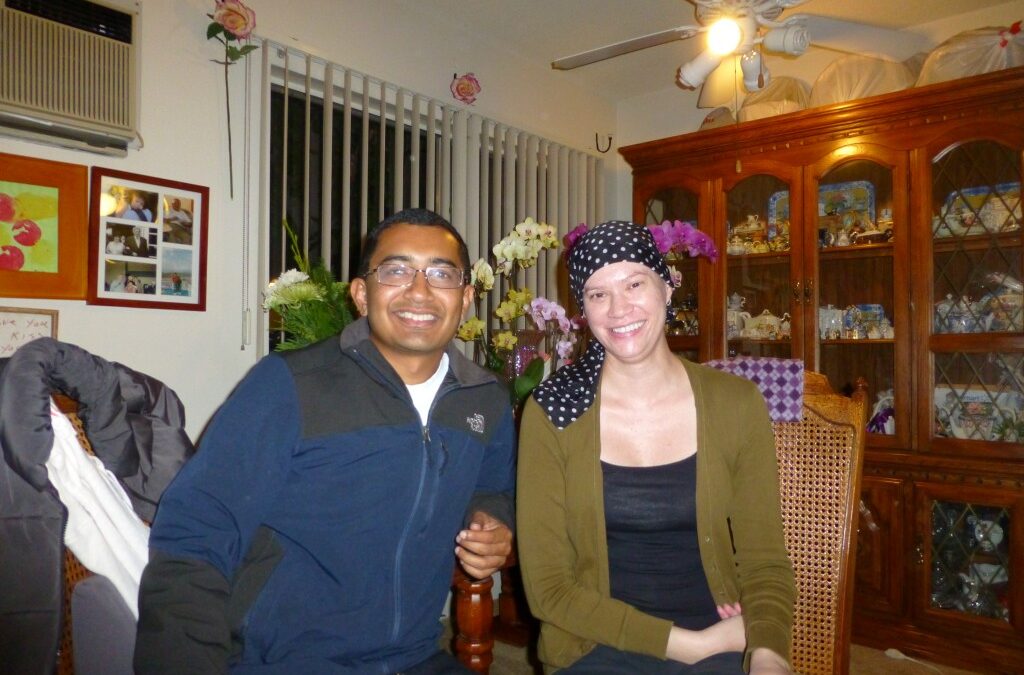
My friend and hero, Marina.
My doctor tried to soften the blow of the bad news by telling me that I caught it early.
Then I heard the words that would terrify and frighten anyone.
The diagnosis: breast cancer.
Imagine receiving this news just 3 weeks after your dad had passed away.
I decided not to tell my mom about my diagnosis right away because she was in a vulnerable place, already having lost her life partner. I also wanted to have all the answers to any questions my Mom would have before I told her about the diagnosis.
After some tests were done, I sighed a little with relief when I discovered that the breast cancer was at Stage 1 and was the size of a small coin.
Although the doctor tried to assuage my fears by confidently telling me my life wasn’t in danger, the next year was not an easy one.
My doctor told me I needed to have a mastectomy (breast removal surgery) rather than a lumpectomy (breast-conserving surgery). I’m glad that decision was made for me and I didn’t have to make it myself.
My cancer journey began with surgery, followed up by chemotherapy starting approximately 2 months after my surgery.
The doctor explained that I needed additional chemotherapy because I was very young. Women are more likely to be diagnosed with breast cancer later in life (with the highest percentage of women being diagnosed in their 60s and 70s).
Statistically speaking, I still had a long life ahead of me, which meant I had a longer period of time in which the cancer could return. So chemo was supposed to reduce that chance of reoccurrence as much as possible.
I was the youngest patient in the room receiving chemo treatment, so I imagined I could handle it.
Unfortunately, I was wrong.
Chemo kicked. My. Butt.
Within 24 hours of my first round of a chemo session, my stomach and back were throbbing with pain.
I had no appetite and felt exhausted.
Within 48 hours, I had blurry vision and was getting hot flashes. Within 72 hours, all of my joints ached and I felt like a 90-year-old woman, and I had difficulty processing thoughts. It felt like everything was happening in slow motion.
Losing my hair.
But with all of those unpleasant side effects, what I feared most was the day my hair would start falling out.
My doctor informed me it would take about 2 weeks for my hair to start falling out, so I waited anxiously.
I remember the first huge clump of hair falling out, enough to fill my entire fist. If I had been in denial up to that point, it stopped that day. I really was sick.
I decided to shave my head rather than waiting for the rest of my hair to fall out. It was the only thing I could do to gain back some of the control I had lost.
I recalled so many times in the past where I complained about having a bad hair day. It seemed so trivial now as I was looking at myself in the mirror with barely any hair.
Healing my body. Changing my outlook.
My chemotherapy sessions, treatment and healing continued over the next year.
Eventually my hair grew back, the stomach pains subsided, and I got my energy back. Physically, I was starting to look like the old me.
But the inside is where I experienced the most unexpected changes and growth.
I was different. Some people say that getting cancer didn’t change them. Well, that wasn’t the case for me.
Cancer changed me. And not in a bad way either.
Cancer opened my eyes.
It taught me the importance of gratitude.
When I started feeling physically better, I started appreciating the simple things in life.
Meals, phone calls to friends, going for a walk … all of these things have more meaning than they did before.
It’s amazing how being grateful started a chain reaction with regards to other aspects of my life.
I smile more, gossip less, and I’ve become more active and adventurous in life.
When you get a glimpse of how fragile and painful life can be, you begin to appreciate and embrace it a lot more.
Besides being more grateful, I have also learned to be more “selfish”.
Okay, it’s not really being selfish as much as I am now more aware of what I want, and I don’t ignore those feelings.
It’s surprising what I used to do out of obligation or guilt to the point where it caused me stress.
For example, I maintained friendships that weren’t healthy. That’s no longer the case. If I don’t want to do something, I don’t do it. I say “no” more often.
Unfortunately, I do not have any tips on how to reach this peace that I have found. There’s no 10-step process that I can recite.
All I know is that I don’t think I could have gained this understanding without being fully stripped down, and that’s the irony.
Am I glad that I got cancer? No.
Did I get something beautiful out of this that I wouldn’t have discovered any other way? I think so.
I went through a lot of obstacles that year, but through it all, I have learned to love my life, appreciate the small things and value myself more than ever.
Oh, and I do have a little advice – be wary of who you sit next to on the first day of class. For example, you could start your first day of law school sitting next to someone named “Vishnu” and be pestered into writing a blog post for him ten years later.
Marina is not a blogger and never could have imagined herself sharing such a personal essay. (Thank you for your inspiration and courage, Marina 🙂 )
Have you survived a horrific illness or health problem? What were some of the lessons your injury, illness or disease taught you? Please share in the comments section below.

by Vishnu | Nov 18, 2013 | Faith, Optimism, Overcoming Challenges, Uncategorized
A flicker of hope
“Hope is being able to see that there is light despite all of the darkness.” Desmond Tutu
When I was going through a breakup and divorce, my life was filled with darkness. The end of an eight year marriage, the pressures by our families to stay together and the pending divorce proceedings were overwhelming and soul-crushing.
A blogging friend of mine had been unemployed for a little more than a year. When she left her last job, she didn’t realize that the tanking economy would take her through a roller coaster period of unemployment. The mental and emotional pressures continued to build up month after month.
Another friend from college was diagnosed with breast cancer when she had just turned 34 years of age. With her father’s recent passing and her diagnosis, making it through each day was a struggle.
How do you persevere when your future looks bleak? How do you move forward when you feel like you can’t?
How do you cultivate hope at your life’s absolute lowest points?
When the path seems uncertain and the future dark, cultivate these ten states of mind and beliefs to persist in the darkness:
1. A belief in a better tomorrow. A conviction that what’s happening doesn’t have to always endure. Another day can bring new circumstances, new opportunities and new solutions to improve the situation you find yourself in.
You can’t fall back much farther when you’ve hit the depths of despair.
It can and it usually always does get better.
2. Keep going even when you’re uncertain about the future. One of the scariest feelings you confront is having an indeterminate sense about your future.
How do you ride your bike along an unknown path? How do you forge ahead when you can’t see where you’re going?
Even when you’re uncertain of the path and can’t see in the dark, keep moving forward knowing that you will have more clarity with each step.
You don’t have to know exactly what the future brings, but know that you have more control in what can happen than what occurred in the past.
Trust your intuition and double down on hope knowing that you’ll see glimmers of light and direction soon.
3. Don’t allow roadblocks to halt your journey. As you move forward, you will stumble upon more bumps in the road: obstacles, setbacks and delays.
You can allow these roadblocks to get in the way or you can be determined to move past them and accelerate.
Think of roadblocks as pebbles in your path that can be cleared instead of unmovable boulders that paralyze you.
There is a solution to every obstacle you face. Often, it just takes creativity and persistence to prevail.
4.Life lessons are teachers. Being hopeful means using the problems and challenges which confront you in a positive way.
Each difficulty and obstruction can reveal something to help improve your life.
What is the wisdom that’s contained in the obstacle confronting you?
There is always a lesson there. Your job is to simply find it.
Don’t ask, “why me” or “why did this happen”. Instead, ask: what can I learn from this today?
5.Pain transforms. If you’re going through a throbbing life event that is tearing at your heart and soul, be aware of the tenderness and hurt.
Once again, there are many lessons and insights your life’s most painful events can teach you.
Once you can acknowledge the pain, allow hope to alter the pain into a gift that can be used for the next steps in your life.
If you can view your pain as a gift of steadfastness and strength, you’ll be better prepared for all the current and future hitches you’ll confront in your life.
6.Keep hope thriving. It’s easy to want to give up or throw your hands in desperation. Especially when your pain is protracted or the difficulty is too excruciating to handle.
Even in the darkest of hours, allow hope to lead. Progress ahead. Know that persistence will have its reward. Be open to the idea that circumstances will improve.
Your day will come if you can make it through the unknown and demanding stretches. Those who persist, usually prevail.
Focus on all the positive possibilities.
Just because the current situation worsened doesn’t mean you have no control over the final outcome. Know that you can take action to change the outcome.
Hope demands that you surge onward and keep believing in a better tomorrow even in the most agonizing circumstances.
7. Keep taking small steps forward. Having hope doesn’t mean you simply sit back with an intention of a better tomorrow.
Hope is cultivated through action.
To improve your tomorrow, you must take small steps toward improving the situation today.
Brainstorm ideas with friends and families. Explore options. Seek help and advice. Set the problem aside for some time and come back to it later. Seek inspiration from mentors.
8. Allow for inner growth and development. You may not be able to control what’s happening outside of you, but trying circumstances will help strengthen your inner resolve.
Challenges will help you rely on your ability to persist and develop characteristics in yourself you never know you had.
External circumstances help chip away at the rougher edges of your personality and help you connect with your true self.
When life shakes you up, allow for your truth to be heard, your inner core to be strengthened and for character building.
There is no better time to acknowledge the skeletons in the closet and come to terms with them.
Allow adversity to strength you.
9. Hope is letting go. You can’t control every situation and circumstance.
Hope also means you have to let go and allow circumstances to work out on their own, after you’ve done your part.
It’s releasing expectations of a specific result or demand.
The serenity prayer reminds us that wisdom is knowing the difference between accepting the things that we cannot change and the courage to change the things we can.
Hope is anticipating the best when you have no control over what transpires next.
10.Hope wins. Hope is realizing that many have prevailed with hope.
Hope taught me that with each passing day, my life can transform from sorrow to joy, from pain to wisdom and from loss to clarity.
I could wake up again and see a brighter day – divorce was certainly not the end of the world.
My blogger buddy found work in a more desirable city, closer to her family and with more pay.
My friend from college became cancer-free, changed her perspective on life and is now filled with gratitude for all the small things life has to offer.
Even when circumstances don’t unfold in your favor, the lessons you’ll learn and your inner resolve will create a stronger and more fearless you.
Even when trying circumstances persist and challenge you, rely on hope to make it through the rough days.
Let hope be the lantern you carry to shine the light on the path to a better tomorrow.
* Photo credit @killerturnip
Has hope gotten you through some rough patches in your life? When do you cling onto hope and when do you throw in the towel? Anything I missed on living a life filled with hope? I’d love to hear from you in the comments below.
by Vishnu | Jul 28, 2013 | Career, Change, Faith, Overcoming Challenges, Personal Development
A guest post by Melissa Tandoc of the Graciedo blog:
Having grown up in the Catholic faith my entire life in a very religious community and family, the call to know God was growing louder.
At the age of 20, I made a decision which would forever alter the course of my life. I decided to get hitched.
And I’m not talking marriage. I’m talking about a lifelong commitment to Jesus.
Dashing my parents hopes and dreams of a marriage, kids, a nursing career and dreams of going to America, I left it all behind to do something that felt so right in my life – to become a nun.
The calling was so strong. I just had to be with Jesus at that moment. Similar to Mother Teresa, I imagined a life of service to the poor. My mind was set on ‘doing’ things for God.
A journey of faith
The thing is, one has to be formed (prepared) before immersion (living in a mission area). It took several years of Bible studies, theology classes and tests in relationship before the real thing took place.
My spiritual mission started as a nurse in a private school. I asked my spiritual mentors, ‘how come I was assigned there when I wanted to be with the poor?’ However, within the months, I saw that the ‘poverty’ the rich children had there was deficiency of attention from their parents. They had all the material comforts of the world but with psychological and emotional issues of the modern world. I have learned to embrace those children in their needs.
After a year, I was sent to live with the street children. With them, I learned that kindness isn’t in the softness of one’s voice. I learned how to be gentle and firm at the same time. I wanted to stay there with them but God has other plans.
The time came for me to go to a foreign mission and I said, yes, to a mission in North Africa. Preaching in North Africa was a no-no. And even if it were permitted, I couldn’t have done so with the little Arabic that I studied. It came to me as a surprise that some people there spoke Italian (it was an Italian colony before) and it was a huge relief!
Not all patients welcomed the idea of a ‘Christian’ working in their midst and some called me ‘kalba’ (female dog). It took years of working with them to finally call me ‘sorella’ (Italian for sister).
Preaching with words was prohibited but preaching with acts of love and kindness weren’t. Most of them said that, ‘Christians’ lit the dark rooms of the hospital where we worked.
I spent several years in North Africa, being a nun and serving as a hemodialysis nurse.
Maybe I could pause here because the next question will be, “If I were happy doing all these, how come I left?” And that would be another story (and another future post).
In taking this path, here are 5 lessons from my spiritual journey as a nun:
♦ Take life at your own pace. I decided to enter the convent at a time when most of my friends built their careers, dated and created their own families. Instead of following a set path and doing what others were doing, I did things on my own pace and time.
It’s something similar to child or a plant. We grow through our experiences.
Respect your own pace.
♦ Spiritual direction and trust is necessary. The answer to life is not in the formulas nor in the seven-steps to this and that. There are no quick answers nor shortcuts in living life fully.
We need modern day saints, holy more than spiritual people (priests, nuns), who could guide us in discerning our path.
♦ Allow God to lead. Yes, we did psychology to understand ourselves better. But there are limitations to science. We couldn’t rely on psychology to heal us. I dare people to have faith that God works in our lives and to listen to the path that God has for you.
My greatest teacher and mentor, Jesus, was my guide to entering and then leaving this path that I had chosen.
->If religious life is not your cup of tea, then learn to discern . Your inner voice, will tell you.
♦ Go back to the roots. Dig deep. We are taught to forget our past. But I think we should do the opposite. Reread your history with God’s eyes – in faith and openness.
Embrace your past and use your past as an opportunity to grow in faith. In the alternative, use ALL your experiences to be the best person you can be today. You are who you are because of your story.
Don’t dwell in it but don’t forget it neither.
♦ Humility
The lessons learned in the convent are helping me live more humbly in my regular life today.
I am reminded not to have the ‘holier than thou’ attitude or judgment of others. We are all journeying together ~ some further along and others at the starting point.
Where you are on your spiritual journey is fine.
In my next post, Vishnu has asked me to write about how I began a new life outside the convent. Update: Part 2 Unveiled: Why I left? When should you?
To pick up a copy of my book, Is God Listening?, about God, spirituality and resilience, click here.
by Vishnu | Jun 23, 2013 | Forgiveness, Happiness, Love and Relationships, Optimism, Overcoming Challenges
Bro, I need another 18 reasons to forgive her!
I sat on the curb at 2 a.m, in front of my grandparent’s home.
I had never spent the night on the streets of Singapore (or any country really) and having just arrived at midnight, I didn’t want to startle my sleeping grandparents –or have them ring the cops!
I hadn’t told anyone I’d be visiting.
I flung my luggage in front of the iron gates and made myself comfortable on the curb to wait for dawn. I did what anyone sitting on a dimly-lit street at 2 a.m. would do in Singapore: I pulled out my laptop and started reading my friend Galen Pearl’s ebook on forgiveness.
The journey to this curb had been one of the longest journeys of my life. And I’m not just talking about the 20-hour flight from California.
See, I hadn’t spoken to my parents for a little more than 2 years.
During one of the most difficult periods in my life – the most difficult, in fact – my Indian parents aggravated a painful experience by actively intruding in and opposing my separation from my ex-wife.
“What about our family name,” they pleaded. “What will others say about us?”
“You have no choice – you must stay together,” they commanded uniformly.
Being in a place of extreme vulnerability, pain and hurt, I couldn’t handle the added pressure and demands of my parents.
So, we stopped talking. I did, anyway. For 2 years so I could complete the divorce and move on with my life.
I resented them for being unsupportive and choosing to see me in pain rather than alleviate painful circumstances.
This trip back to Singapore was the first step on my journey to forgiveness. I hopped on a flight I didn’t want to take. Struggled to book my ticket, to hop on the plane and sit through a 20+ hour grueling journey. Survived transit lounges, immigration and customs to confront 2 people who had hurt me so much.
And here I was now contemplating how I’d forgive the two people that compounded the pain of my separation and later divorce. The parents who opted for self-interest and family name before their son’s interest.
As I sat on the curb and waited for dawn, I re-read the chapters on forgiveness in the book, 10 Steps to Finding Your Happy Place (and Staying There).
I needed all the advice and inspiration I could get before I would have to confront my parents in the next couple of days and find a way to forgive them.
“To forgive is to set a prisoner free and discover that prisoner was you.” Lewis B. Smeedes
I re-read the forgiveness chapters for the fourth time. Galen recognized forgiveness was a challenge to most, but provided a convincing argument in several chapters of why to forgive someone.
I needed every reason in the book to allow forgiveness into my heart.
Wanting to forgive was why I had gotten on the plane and why I was now sitting on the curb in the middle of a mildly humid Singaporean night.
“Forgiveness is a gift you give yourself.” Suzanne Somers
Here are 6 reasons that moved me to forgiveness during that trip, per Galen’s book, and why you should forgive the people you’re holding grudges against in your life.
1) When victims of tragedy and crimes can forgive, why can’t you? Galen gives an example of the most horrific crime committed on a community of people. For example, the Amish schoolhouse shooting by Charles Robert in 2006 which killed 5 young Amish schoolchildren.
When the community was willing to rely on their faith to forgive an unfathomable crime, are you not able to let go of small or large trespasses against you?
All major religious faiths and traditions encourage forgiveness, one of the most important principles after, ‘love your neighbor’. Religious traditions encourage forgiveness for the most horrific, painful and destructive acts by others.
Why aren’t you able to forgive the person who didn’t send you a ‘thank you’ card?
2) No matter what your reason for holding grudges, you’re poisoning yourself internally.
Are you holding back on forgiveness because you’re upset, angry or wanting to teach the perpetrator a lesson? You’ve probably realized that holding a grudge and not forgiving someone may be “secretly delicious”, as Galen says, but it ultimately hurts you the most.
When you don’t forgive, you’re filled with anger, bitterness and revenge.
Not forgiving will cost you your well-being – physically, emotionally and spiritually.
You think you’re hurting someone else or making them feel your wrath. But the gorilla of anger and bitterness envelopes you daily and your every interaction. Your life and view of the world are blinded by anger, hate and bitterness.
Every relationship and interaction is clouded by your inability to forgive.
* Here’s the big secret about forgiveness: you’re freeing and releasing yourself in the process. Forgiving others benefits you and releases YOU from pain. Your life improves dramatically when you let the grudge go.
3) Even if you’re not ready to forgive, set the intention to forgive. I wasn’t ready to forgive but got on a flight and made the journey back to Asia. I had set the intention to forgive even if I was finding physically and psychologically hard to do so. How do you forgive people who’ve caused you so much pain?
Although I didn’t know how I’d forgive, I forged ahead anyways. If you set the intention to forgive, you’ll start opening your heart to the possibility of forgiveness.
Galen writes that we need, “a willingness that opens the crack in our hardened heart shell just enough so we can breathe in the healing power of compassion and breathe out the toxic bar of bitterness.”
Explore the possibilities of forgiveness. Visualize what it’d be like. See what needs to happen in you to let go and stop the hurting person or their actions from continuing to plague you every day.
4) Forgive radically. Did the wronged act benefit you in some way?
Radical forgiveness is not your traditional way to excuse another but more dramatically to look at the incident as a gift.
What??
While you may have no intention to pardon your ex who broke your heart to a million pieces, your parents who destroyed your self-esteem or your friend who betrayed you, could each one of them have brought forth revelations in your life, paths for growth or self-understanding?
You have to go to a pretty radical place to realize and change your perceptions on the wrong-doer and the pain they caused.
And forgive them while focusing on the many benefits and positive circumstances that came out of their wrong-doing.
Did my parents help teach me how to be there for others in their time of need?
Did they make me want to consider restraint before meddling in other people’s problems or relationships?
Were they trying to show me their love and trying to protect me from the heart-break and pain that came with divorce?
5) Forgiveness transforms pain into compassion. Once you’re able to exonerate someone, you’ve just showered the person and situation with compassion. You’re willing to acknowledge the pain and let go of it.
Forgiving allows you to build your ability to be compassionate to others. It allows for understanding others, excusing their wrongs and redeeming them. If you can extend this kindness to those who pain you, you’ll be better able to live with more compassion towards all those around you.
Compassion brings you happiness and allows you to celebrate the divine quality in others.
6) Forgive to open up paths to be forgiven.
You may want to be forgiven some day too, no?
Although this might be the one of the more selfish reasons to forgiven, I thought I’d add to reasons to forgive by suggesting using the Golden Rule to your advantage.
You’ve wronged others and hurt them. Sometimes, you don’t even know how much you’ve irritated, infuriated or wronged someone else. You may have hurt someone who means a lot to you and who you want to continue to have a strong relationship with.
How would you feel if you could NEVER be forgiven by someone you cared about? Now, do you want to be that person? A person filled with so much indignation and self-righteousness they couldn’t allow their ego to pardon a wrong?
Don’t be that person. Build up your arsenal of forgiveness karma.
There’s someone you need to forgive today. There may be more but there’s probably one person you were thinking of as you were reading this article.
Are you ready to forgive them? Have you forgiven someone and glad you did?
Please add to the conversation in the comments below – your thoughts give me more perspective on these issues.
* Photo credit nme421
![How to Fly when YOU feel like you’re drowning. [9 tips for moving forward]](https://www.vishnusvirtues.com/wp-content/uploads/2013/06/womanflying-300x192.jpg)
by Vishnu | Jun 2, 2013 | Change, Goals, Happiness, Inspiration, Motivation, Optimism, Overcoming Challenges, Personal Development, Perspective
Who needs United Airlines when you can walk on the clouds?
“No matter where you are on your journey, that’s exactly where you need to be. The next road is always ahead.” Oprah
The fancy home overlooking the glistening turquoise sea.
A fulfilling work-life and entrepreneurial career. Planning glamor weddings or writing best-selling books. Managing that talked-about restaurant that caters to celebrities.
Boating cruises on the Riviera with that tall, dark-skinned French doctor of your dreams. Weekend getaways to Cannes, where the film festival makes the bottom of your weekend itinerary.
All right, all right.
Maybe not quite so glamorous but you know what you’ve always wanted; love, career, children, a lovely home, season-tickets to the Teatro alla Scala, tango dancing in Buenos Aires.
Just the basics.
You NEVER imagined you’d be here.
You thought all the pieces of the puzzle were to fall together and your life would unfold as you had desired. Life would be a comforting journey on the ‘It’s a Small World’ ride at Disneyland where you floated around on teacups visiting exotic countries around the world.
Instead, you’ve found it to be like a scary life-or-death, hair-frazzling roller coaster ride leaving you breathless, disjointed and baffled.
What happened to that fairy-tale life you were promised as a kid?
What happened to the life-dreams you had so meticulously imagined in your day-dreams?
Is your dream job more elusive than ever?
Is your career at a dead-end?
The hunk of a guy you’re dating: more punk than hunk?
Your life didn’t quite turn out the way you imagined. Instead of flying, you feel like you’re scuba diving. Scuba diving without an oxygen tank. Ok, feels like you’re drowning.
Did your life turn out the way you wanted?
Why did you get left behind?
Why is everyone else moving ahead?
Why is everyone else’s life falling into place like a 10-piece jigsaw puzzle when your 1000 piece jigsaw puzzle is scattered across three rooms, missing 150 pieces and is hardly recognizable?
The life I wanted seems so distant.
When I completed my law degree, I spent several years of my life as a courtroom lawyer but was never a fan of the practice. Instead of sticking with law, moving up the partnership track and getting paid!! ($$) I’ve jumped out of law practice all together. It didn’t fit my soul, personality or interest so I bid it farewell. But it set me back a few years professionally.
I married at the age of 25. Like most who walk down the alter to wedded bliss, I wanted this marriage to last a lifetime. Forever. Happily ever after, as fairytales end. A long life together, happiness and children. But it didn’t work out that way. In fact, we married too young, learned we weren’t right for each other and and divorced much later than we should have.
Yup, life wasn’t what I had wanted it to be and the life I desired seemed obscure.
What next? What do you do after the sense of failure has pinned you against the wall? After the frustrations have set in and the tears have dried up?
Your journey back to your life starts with:
1) Resist your desire to compare yourself with others. You don’t know the 99 problems Jay-Z’s got. You don’t even know 99 problems your wealthy girlfriends, attractive exes or bff’s have. Life may appear grand on Facebook postings and idealistic on Christmas cards but you have no idea what deranged and lunatic people your friends and family are.
The more ideal their lives appears, the more likely you’re going to be reading about them in the tabloid papers or TMZ.
2) Let your life work out on its own pace. No two journeys are the same (except in prison where your daily routine, clothing, bedding and food options are the same.) We each have different lessons to learn and different experiences to have.
You need the setbacks, experiences and lessons learned to shine in the future.
3) Be grateful for who you are. You’re a divine being. You just forgot about that as you grew up and people around you told you otherwise. As a baby, you were coddled, petted and treated like a precious gem. As an adult, you’re now treated like Amanda Bynes or Justin Bieber on a bad day in court.
You’re not a disgraced pop star or reality tv wannabe. Be grateful for you. Be grateful for your talents, abilities, mind and consciousness. Be grateful for the gift you are to the world.
4) Be grateful for everything you’ve got. Yes, your flat screen tv. Your diplomas, master’s degrees, student loan payments and photo frames. Your Gucci sunglasses. Startucks coffee-cards, Nina Fern pumps, weekend spa retreats… Your 18 silk scarfs. Your 10-year-old Volkswagen Jetta which drives without protest or resistance. You’ve got food and friends to eat it with. You’ve got a job, however dead-end it might be.
Whatever you have, small or grand, be thankful for it. There are no downsides to a gratefulness practice.
5) Keep hope alive. “We must accept finite disappointment. But never lose infinite hope,” Martin Luther King, Jr.
Even if your life feels like it’s out of sync and far from the day-dreams you had growing up, never give up hope. The life you dreamed of may not be exactly as you had wanted but it will manifest in its own way. Huh?
What you want will manifest itself in a different form than you had expected.
You might have wanted children of your own,but for now you have nieces and nephews who you enjoy spending time with. They love your company, but they go home after, saving you your sanity and sleep.
You dreamt of being a financial advisor at a large New York stock brokerage. The good news is that when the market tanked, you didn’t have dozens of angry clients trying to break down your door. Instead of doing it professionally, you’re able to make smart investments for your family members who ask.
You didn’t make it into Hollywood but you’re teaching children how to act and making a difference in the lives of dozens of future actors.
Stay positive and hopeful that the universe will manifest your desires.
Any day.
It may not be exactly as you had wanted but what the Universe felt you needed.
6) Improve your mindset and raise your vibrations. You’re not going to read a personal development blog without hearing this advice, but it has to be said. Or you have to be reminded.
If you’re a highly negative person, this advice goes double for you.
If you believe positive thinking is a bunch of poppycock and wondering why there’s so much negativity in your life, you might have a problem.
Thinking positive thoughts is not going to mean a house in Beverly Hills and a fat movie contract. It WILL allow for more positive affairs (no, not that kind) to manifest in your life.
Also, hand in hand with positive thoughts are positive vibrations. How in the Universe do you raise your vibrations? My friend Evelyn has some thoughts.
7) Practice patience. Yeah. Wait.
Some people I know are doing this as a spiritual practice or using it for their word of the year in 2013. Life isn’t a fast food drive-thru or quick-delivery pizza: 30 minutes or it’s free.
Didn’t someone say the best things in life are worth waiting for? So wait a little longer and your many wants and desires might manifest in front of your eyes. And much more than you initially wanted or expected.
8) Clean your house. I’ve always found that prior to my external world improving, I’ve had to improve my internal world.
“Vishnu,” you’re asking, “did you just get back from a taping of Oprah?”
No, friends, I’ve experienced this.
When you’re a mess, your world is a mess. So, how do you improve your inside world?
Yoga, sure. Meditation, fine. Serious therapy and medication, ok. Standing upside down and chanting to the spirit Gods – whatever works, mate.
What do you need to deal with serious or even small emotional and psychological issues you’re facing? IF you’re thinking reading this blog is going to get you there, God help us all.
Get help.
9) Be open to the tidal waves of change and gifts coming your way. Yeah, sometimes life’s like Christmas except you won’t know what day Santa is going to break into your pad and shower you with every gift you’ve ever wanted.
In fact, your life may already be like Christmas morning and you’ve failed to take notice.
If you’re living the dream and still feel unfulfilled, go back up to the “gratefulness” parts of this post.
If your dreams and wants in life seem far and distant, then be ready to accept your desires unfolding. Don’t shut the door on the extremely attractive delivery man who delivers you a bouquet of flowers. (Oh, do make sure that flower delivery guy is delivering flowers as his part-time job and that he’s studying to be a dentist during the day)
Be open and observant of what’s happening in your life. Allow your life to manifest what you want in it.
Don’t take another step or leave this post without heading over to the comments section below. Give it to me straight – are you waiting for your life to start or pressing ahead and living it?
![5 Challenges When Returning to the Homeland [Portland –> Philippines]](https://www.vishnusvirtues.com/wp-content/uploads/2013/05/purplepanda-300x199.jpg)
by Vishnu | May 19, 2013 | Culture, Happiness, Inspiration, Optimism, Overcoming Challenges, Personal Development, Perspective, Purpose, Spirituality
Janet Brent - sooooo Pinoy!!
I’m a first generation Filipino immigrant to the United States and I’ve got a legit American passport to prove it.
In our first-time plane journey, Mom and I flew to the U.S. from the Philippines to begin our new lives. It all started from one of those pen-pal services that my mom joined pre-online dating sites. Sounds like a ‘Mail Order Brides’ kind of operation to me but who am I to judge?
Mom did what she had to do. All she selflessly wanted was a better life for me.
I spent my whole life growing up in the States; from pre-school through college.
I even worked my first two “professional jobs” in the U.S. We’d visit the Philippines every couple years if money allowed it and when I had those long summer vacations. My last visit was at the age of twenty with Mom. By that time, I was already telling my Tita (aunt) that I wanted to visit on my own next time and really travel the Philippines.
I forgot about this prophetic comment until my next visit six years later. I was twenty-five going on twenty-six.
Newly emerged from a self-proclaimed “quarterlife crisis” in which I had let go of a 5 year long relationship complete with house, mortgage and a dog. That was slowly killing that fire within, that frees-spirit, that wanderlust that I always had. I knew I had to make big changes and so I walked away.
I uprooted my entire life just to reverse all the opportunities I’d known to embrace my Filipino culture and living with my own people.
I thought returning home would be ‘a spiritual coming home’ experience – a return to my roots. I was going back to the homeland. I’m still here now, but it ain’t all bed and roses. Sometimes, it’s wooden floors and coconuts. It’s a strange sort of culture clash, when you’ve all but lost your own culture.
5 Challenges of Returning Home
1. IDENTITY or “Being Told I’m not Pinoy.”
The term ‘Pinoy’ is used to describe a person from the Philippines; a Filipino.
Pinoy can also refer to the native culture of the Philippines. e.g. “Woke up to bad karaoke blasting from the neighbors singing Michael Jackson’s ‘Beat It’. That’s so Pinoy!”
I have had many times, especially during when I first landed, where people have told me to my face that I am ‘not Pinoy’.
Who am I if I’m not even Filipino?
Are Filipino-Americans, particularly the Filipino-Americans who don’t know their own language fluently (guilty), such aliens?
Am I a freak?
Do I not belong in my country of birth?
Who am I if I’m not Pinoy?
The comments stung as I grasped for a sense of my own ever-changing identity.
Who am I if I’m not Pinoy and these aren’t my people? Identity is a real bitch. Each devaluation, regardless of the cultural context (OK, so I know I’m not as “Pinoy” as I am “American”), is a kick in the gut. It hurts.
2. ICE COLD SHOWERS or “Going Native.”
Joel Runyon, who runs the popular Impossible HQ, thought it would be weird and crazy to take cold showers for a month just because he can.
I mean, who does that!?
Filipinos.
And probably a big chunk of the world population not in the top 8% we call America. Cold showers are a reality for developing countries and “going native”.
Filling buckets of cold water and using little “dippers” to dump water over my head is a reality for most, especially in the province (Bonus points if you can do this outside with your clothes on. DOUBLE bonus if you can do this outside in your birthday suit. Context is everything. And if you’re wondering, heck yeah, I’ve done both.).
Despite the humid, hot environment, cold showers still take some getting used to.
My technique?
Grabbing my boobs with both hands to cover them while simultaneously jumping up and down with flip-flops (it’s weird to shower barefoot) under the shower. Once I get used to the temperature I let go of my boobs and hang loose, baby! So who’s the crazy one now?
3. CULTURE SHOCK or ‘You’re so yuppy!’
Culture shock is a broad category that can cover a myriad of situations and examples.
But the opposite of ‘Pinoy’ and not being culturally “native” is being ‘sosyal’ (think “social” with an accent). This term refers to the higher-class, often “yuppy” groups of Westernized socialites and urbanites out of touch with their native culture. These social elites live in high rises and not the bahay kubo (“high rise” house on stilts made out of bamboo that the provincial poor dwell in).
I am the LEAST poshy least social person ever and I live in the slums but I still get labeled ‘yuppy’ because it also refers to the mindset, if not the lifestyle, of a Westernized person.
(By the way, things like using utensils to eat instead of a fork and spoon gets you marked a sosyal!?!)
4. GIMME A KISS AND YO’ US DOLLARS or “Family Obligation.”
Money is a real bitch here, and family members are expected to help out collectively, for the greater good of the family. That’s all fine and dandy but it also means you can get taken advantage of as the “rich” Westerner. This was completely new to me having gone back for the first time by myself.
This is a huge culture shock for someone trying to travel and live on a budget!
Add to this the passive-aggressive communication style. How my aunts would call my mom on the phone to talk about how I wasn’t paying and my mom would call me to tell me I needed to pay. Big turn off.
To this day, I still hesitate visiting knowing that I’m expected to shell out money, and being guilt tripped if I don’t.
Now that’s so Pinoy!
At my current rate, trying to build my web/blog design business (www.byjanet.net), I’m just trying to survive like the rest of the ‘Pinoys’, with very little money to spare.
5. SLUMS or “I’m a Survivor.”
My life is so much different than it was a few years ago. I am now living in the Manila slums when I found my money run dry and was faced with living in the cheapest rent of the city that I could find.
This is like a season of “Survivor” but I guarantee you there’s no million dollar grand prize if I survive.
Not surviving means not making rent or having dinner!
My ‘coming home’ path wasn’t the path I had imagined but I’m certain it is the path that will ultimately make me succeed as a person.
Coming home does have it’s plusses – I am with my people (like it or not) I speak Tagalog daily (so Pinoy!).
I eat with my hands (more often at least) I’ve learnt persistence, survival skills and become more of a local than when I first landed here.
You know what? It feels good to be home.
Did you enjoy Janet’s story? Have you had to ‘go home’? Was your return home anything like Janet’s experience? We’d love to hear from you in the comments below
Janet Brent is a straight-up Pinoy, still living in the Phillipines and chasing her entrepreneurial dreams. She works with creative and holistic writers and authors to build web platforms, design ebooks and assists with product launches over at the Purple Panda. She’s also living on $2 U.S. dollars a day this month.


